
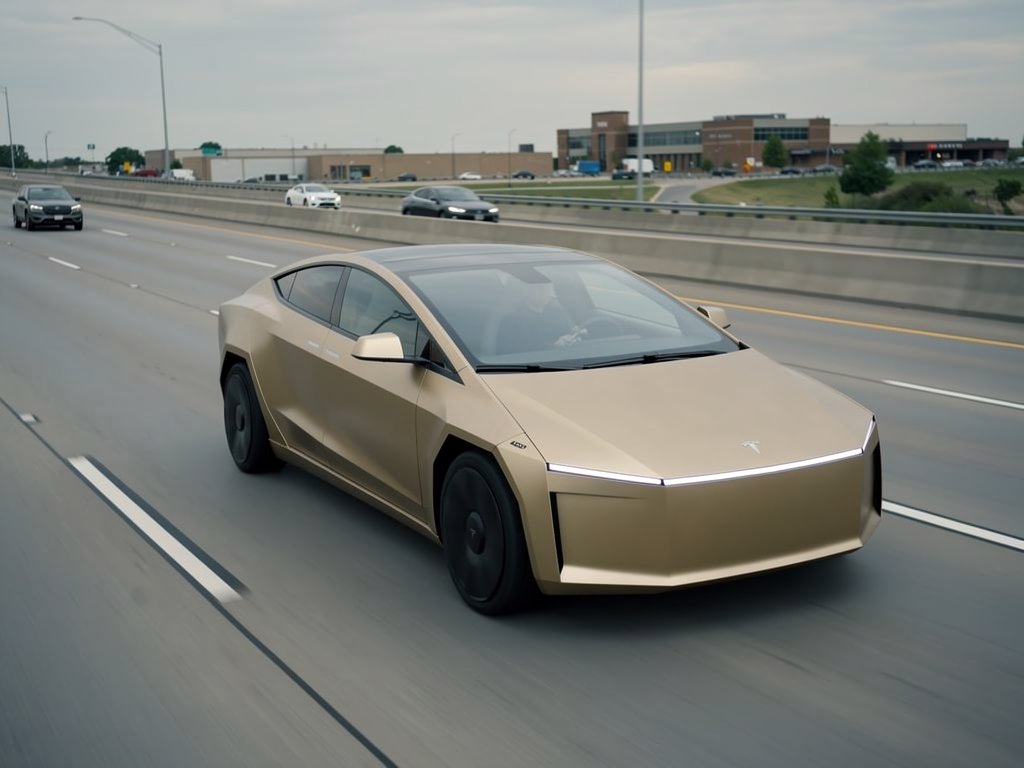
Tesla's Cybercab — the steering-wheel-free, two-seat purpose-built robotaxi that entered mass production at Gigafactory Texas in April — has been involved in its first publicly documented public-road accident. Images shared on 13 May 2026 by X user @bigcolll show a champagne-gold Cybercab in a multi-car incident, with the visible damage pattern indicating the robotaxi was rear-ended by the vehicle behind it and pushed into the car in front (Not a Tesla App).
No injuries have been reported, and Tesla has not commented publicly on whether the Cybercab was operating autonomously, under human supervision, or stopped at a traffic control at the moment of impact.
What the Photos Show
The shared image captures three vehicles: a passenger car ahead of the Cybercab, the Cybercab itself with rear damage and front-end contact, and the trailing vehicle whose front end is visibly crumpled. The classic kinematic signature — the lead car shows rear damage, the trailing car shows front damage, and the Cybercab in the middle carries both — is consistent with a chain-reaction rear-end struck from behind.
This aligns with how the bulk of incidents involving autonomous vehicle fleets in the US play out. Waymo's published safety telemetry has long shown that the dominant collision type its vehicles experience is being rear-ended by inattentive human drivers — usually while the AV is stopped at a light or yielding (Teslarati).
Why It Matters for Tesla's Robotaxi Push
The Cybercab is the most regulator-watched vehicle Tesla has ever fielded. It has no steering wheel and no pedals, which removes the human-takeover fallback that Tesla relies on for the Model Y- and Model 3-based Robotaxi service operating in Austin. Every public-road incident gets folded into the dataset that California's DMV, NHTSA, and increasingly the European Commission's AV working group use to set the rules under which a no-controls AV can be sold or operated.
A single rear-end from a human driver behind a stopped AV is, on its own, a non-event. But it gives Tesla its first chance to demonstrate the post-incident telemetry quality that competitors like Waymo and Zoox already publish — speed at impact, vehicle state, sensor data, occupant detection. How quickly and how openly Tesla shares that information will inform how the EU AV approval process treats the platform when (or if) Tesla files for type approval.
Production and Public Testing Status
Tesla started high-volume Cybercab production at Gigafactory Texas in April 2026 (Tesla Cybercab — Wikipedia), and prototype units have been spotted on Texas roads since early May. A separate Cybercab mule with a steering wheel and mirrors — almost certainly a validation/test platform rather than a production-shape vehicle — was photographed in California earlier this month. The fleet remains in a closed test phase: no member of the public has yet ridden in a Cybercab on a paid Robotaxi run, and California's new driverless-vehicle ticketing law adopted in April adds a second layer of compliance Tesla now has to clear before commercial operation begins on Californian roads.
What This Means for Europe
The European launch picture is even further out. The Cybercab is not yet listed on Tesla's European order page, and the EU's Implementing Regulation on autonomous vehicles requires either a national-level pilot exemption or a fully homologated Level-4 product before any service can operate — neither of which Tesla has filed for. EU member states have very different appetites for AV pilots: Germany's Autonomous Driving Act allows Level 4 pilots only on pre-mapped, regulator-approved corridors, and France, the Netherlands and Norway have all opened individual no-controls AV pilot schemes that Tesla could in principle apply to. None of those routes is fast: a typical homologation timeline runs 18-30 months once a manufacturer files, which puts a realistic earliest European Cybercab passenger service no sooner than late 2028.