
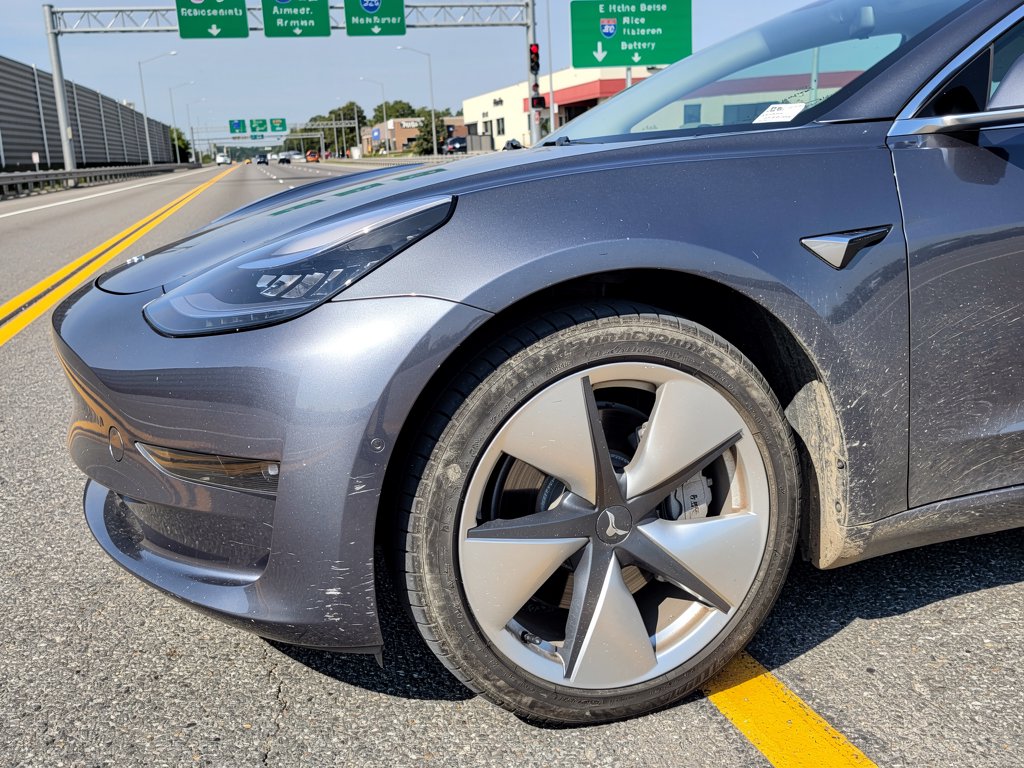
A 2019 Tesla Model 3 Standard Range Plus running its original Panasonic NCA battery pack has now covered 380,000 miles, or roughly 610,000 km, according to a video published by the Canadian YouTube channel Drive Protected. The case is not a manufacturer test or a Tesla press fleet — it is a customer car that has covered the equivalent of 15 trips around the equator on a single, never-replaced battery. The data is the kind European prospective buyers rarely see, and it sets a useful upper-mileage marker for what a high-cycle Model 3 actually looks like.
The Numbers
The car was sold new in 2019 with an EPA range of 240 miles (386 km). The pack now displays 158 miles (254 km) when fully charged. That is an 82-mile loss, or 34.2% of the original capacity, sustained over 380,000 miles. The pack is a Panasonic 2170 cell using nickel-cobalt-aluminium chemistry — the chemistry shipped on US-built Standard Range Plus cars in 2019, before Tesla started rolling out the lithium-iron-phosphate option for the same trim in late 2020 and 2021.
| Metric | Value |
|---|---|
| Vehicle | 2019 Model 3 Standard Range Plus |
| Battery chemistry | Panasonic NCA, 2170 cells |
| Mileage | 380,000 miles (610,000 km) |
| Original EPA range | 240 miles (386 km) |
| Current displayed range | 158 miles (254 km) |
| Capacity loss | 34.2% |
The Highway Test
Drive Protected's test was a real-world highway run rather than a bench measurement. At a steady 68 mph (109 km/h) and ambient temperatures of 51.8 °F to 73.4 °F (11 °C to 23 °C), the car covered 138.3 miles on a full charge before needing to recharge, consuming an average of 4.27 miles per kWh — that is 14.55 kWh per 100 km, a figure broadly in line with what European Model 3 SR+ owners report on similar weather days. The total energy used was 32.4 kWh.
That efficiency number is the surprise. Even with a third of its capacity gone, the pack still moves the car at the same energy cost per mile as a fresh one. What has shrunk is the range; what has not shrunk is the efficiency per kilometre.
How This Compares
Independent fleet studies have generally pegged Model 3 capacity loss at roughly 8% over the first 100,000 miles and around 12-15% by 200,000 miles. Extrapolating those curves to 380,000 miles gives a band of 25-35%, which is exactly where this car has landed. So the headline-grabbing 34% figure is not an outlier — it is the high end of the expected curve for a car that has been worked harder than almost any other Model 3 in service.
Nothing else has been replaced beyond consumables. No drive unit swap, no cell-bank refresh. The car still passes its own Tesla diagnostics for steering, suspension, brakes, and traction.
What This Means for European Buyers
The practical lesson for the European used market is twofold. First, even an extremely high-mileage Model 3 with no battery work is still a viable daily car, just with a tighter range envelope. Second, capacity loss compounds non-linearly: most cars on European roads with 100,000-200,000 km on the clock should still be inside the 8-15% loss band, well below the 158-mile range the 380,000-mile car now shows.
If you are buying a used SR+ in Europe — particularly the 2019-2020 NCA-pack cars that arrived through the Netherlands and Norway before the LFP variant took over — ask the seller for a full-charge range read on the dash and use it as a proxy for capacity. A car displaying within 90% of the original WLTP figure is in normal territory; anything below 80% should prompt a pack-health check at a Tesla service centre.