
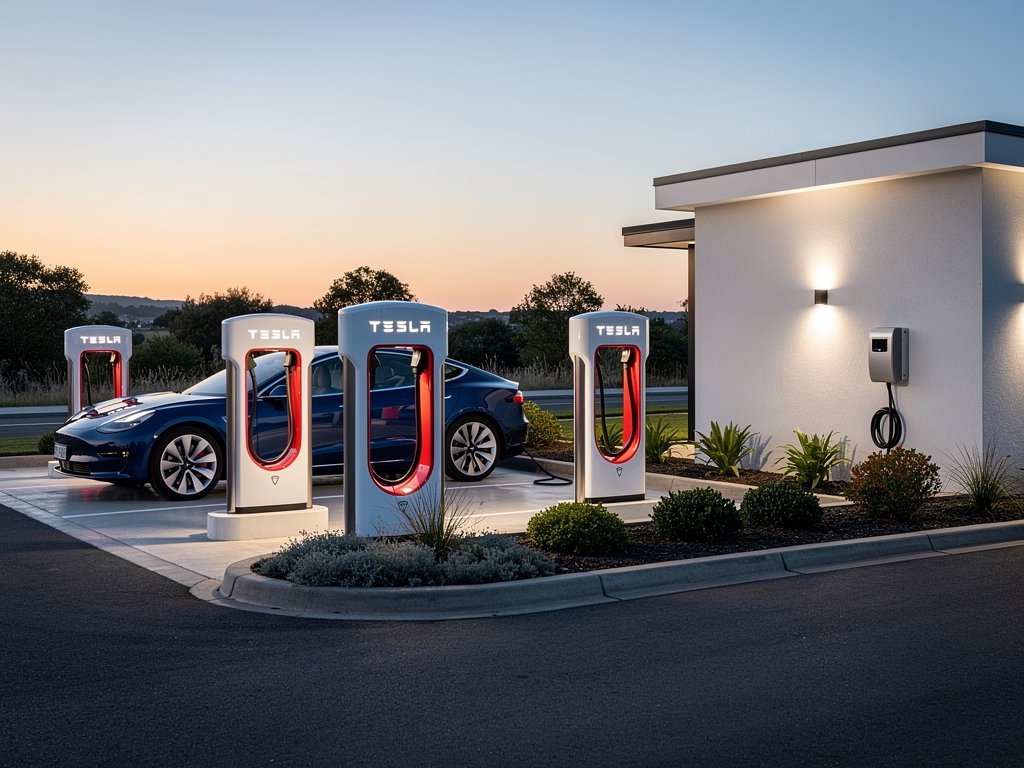
Tesla has introduced a new Remote Meter accessory for the Wall Connector (Gen 3) that lets the charger see how much electricity the rest of the home is drawing in real time. The meter installs in the main electrical panel and feeds live load data back to the Wall Connector, which then slows or speeds charging so the total household draw stays under the service limit.
Tesla calls the underlying feature Dynamic Power Management. It is not new in concept — third-party load-balancing kits have existed for years — but until now Tesla had only offered it as a built-in feature of the Powerwall ecosystem. The Remote Meter brings the same logic to homes that have a Wall Connector but no battery storage.
What It Does
The Remote Meter is a small device with current transformers (CTs) that clip around the incoming service conductors in the breaker panel. It measures live amperage on each leg of the panel, transmits the data to the Wall Connector either over Wi-Fi or an RS-485 wired link, and the charger then adjusts its own draw to keep the total within a set ceiling.
The practical effect is that a homeowner with a 100A service can install a 48A Wall Connector without tripping the main breaker when the oven, dryer, and heat pump all run at the same time. The charger simply backs off — sometimes all the way to zero — and resumes once the rest of the load drops.
Why It Matters in Europe
The feature is more useful in Europe than in North America for two reasons. First, European homes typically have lower service capacity than US homes: many older Italian, Spanish, and Czech apartments are limited to a 3 kW or 4.5 kW supply contract, and a 7 kW Wall Connector on those services will trip the main fuse the moment a kettle joins the circuit.
Second, several European grid operators now charge demand fees based on the peak 15-minute power draw in a billing cycle. Dynamic Power Management lets the Wall Connector smooth charging across the day so a single EV session does not set a new monthly peak. Spain, Portugal, and parts of Italy already use this billing model; the Netherlands and Belgium are moving toward it.
Installation Notes
The Remote Meter requires installation by a qualified electrician — the CTs clip around live service conductors, which means the panel needs to be opened with the main switch off. Tesla recommends an external Wi-Fi antenna if the meter is installed inside a metal panel, because the steel enclosure attenuates the signal. RS-485 wiring is the more reliable option but means running a small cable from the panel to the Wall Connector.
Tesla has not published a separate European price for the accessory. In North America the Remote Meter is listed at the Tesla online shop at $150. Compatibility is limited to the Gen 3 Wall Connector — the older Gen 2 unit does not have the firmware needed to accept the load signal.
For European Tesla owners with limited grid service or peak-demand billing, the Remote Meter is the cheapest way to unlock fast home charging without paying for a service upgrade. For everyone else, the gain is incremental: most modern Western European homes already have 11 kW or 22 kW service and will charge at full Wall Connector speed without ever bumping into the breaker.
Update: 2026-05-14
Tesla's official Shop pricing for the Remote Meter is $210 in the United States and $285 in Canada, not the $150 figure published at launch — the lower number circulated briefly before Tesla's storefront listing went live and has since been corrected. The kit ships with the meter unit, two 200A current transformers, a voltage-sensing cable and a Wi-Fi antenna, and is now confirmed compatible with both the Gen 3 Wall Connector and the Universal Wall Connector. Tesla still recommends professional installation by a Tesla Certified Installer.