
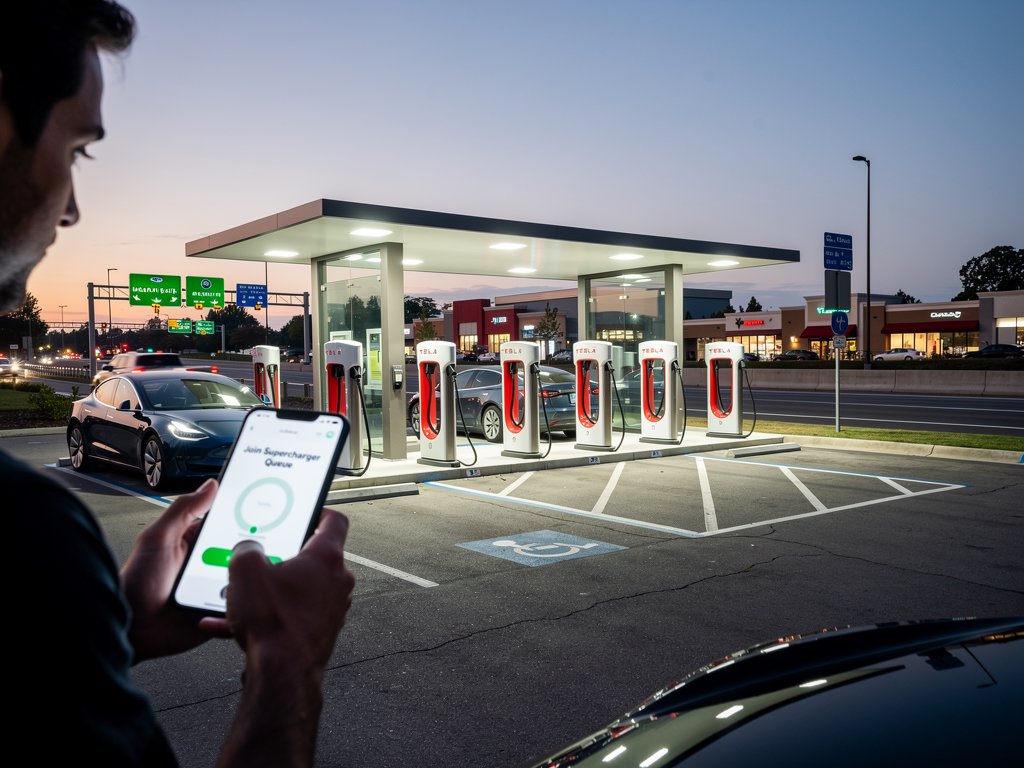
Tesla has begun a pilot of its long-trailed Supercharger Virtual Waitlist, a feature that lets drivers join a digital queue through the Tesla app when a station has more cars arriving than free stalls. The first deployment covers six pilot sites, with the bulk in California and one in the Bronx.
How the Waitlist Works
The system kicks in automatically when a busy Supercharger is set as the destination in the navigation. The Tesla app reads that the site is over capacity, queues the vehicle, and pushes a notification telling the driver their position in line and an estimated wait. When a stall opens, the driver gets a chime and a short window to plug in before the next car is invited up.
Tesla has confirmed the waitlist also works for non-Tesla EVs that are signed in to the Tesla app and using Supercharger access through the Magic Dock or NACS — the same flow Tesla introduced for cross-brand charging in 2024.
Where the Pilot Is Running
The six pilot sites are concentrated in dense, urban Tesla markets where overcrowding is most common.
| Pilot Site | State | Type |
|---|---|---|
| Los Gatos | California | Urban |
| Mountain View | California | Urban |
| San Francisco | California | Urban |
| San Jose | California | Urban |
| Bronx (East Gun Hill Road) | New York | Urban |
| Sixth California site (not named) | California | Urban |
Five of the six are in California, where Tesla has the highest fleet density in the world. The Bronx location is the first East Coast deployment and the first outside California, which signals Tesla intends to scale the feature beyond a single state once the data looks clean.
Why Tesla Built This
Supercharger overcrowding is rare at most sites but unmanaged when it happens. Without a queue system, drivers fall back on local etiquette — first come first served, sometimes a handwritten paper list at the busier urban sites. Disputes are rare but real, especially at airports and city-centre stations during holiday weekends. Teslarati reported earlier in 2026 that Tesla has been quietly building queue infrastructure in the app for over a year, and the public pilot is the first time the feature has surfaced to ordinary drivers.
The feature also lays the groundwork for a different kind of Supercharger experience. Once a car is in a virtual queue, the driver can drift to a nearby cafe or shop rather than circling the lot, and Tesla can balance load across a city by suggesting an alternative site with a shorter wait — a routing optimisation the app already does for slow stalls.
What European Owners Should Expect
The Virtual Waitlist is a software feature, not a hardware change, so it can roll out to any Supercharger globally as soon as Tesla flips the flag for that region. There is no announced timeline for a European launch, but Europe has its own clusters of overcrowded Superchargers — V2 sites along holiday corridors in France, Germany and Italy, and central-London Tesla stations during weekday peaks — that would benefit from exactly this kind of queue management.
For Magic Dock and NACS users in Europe (already live in pockets of France and the UK), the cross-brand queue support means non-Tesla EV drivers will get the same fair-queueing treatment as Tesla drivers once the feature arrives. That is a meaningful signal for how Tesla intends to manage shared infrastructure as the Supercharger network opens further to other brands across the continent.
Update: 2026-05-13
On 12 May 2026, follow-up reporting from Electrek and Not a Tesla App confirmed the Virtual Queue pilot is running at five locations, not six: Los Gatos, Mountain View, San Francisco and San Jose in California, plus East Gun Hill Road in the Bronx. The earlier suggestion of an unnamed sixth California site has not been corroborated. Tesla confirmed cross-brand support — non-Tesla EVs can join the queue through the Tesla app — and said the company will scale the feature if the data from these five sites holds up (Electrek, Not a Tesla App).
Update: 2026-05-19
On 18 May 2026, Not a Tesla App published the first real-world demonstration of the Virtual Queue feature, with photos and video showing the in-app waitlist tracking position, the Live Activity notification on iOS and the three-minute claim countdown that runs when a stall opens. The first-look footage also exposes a structural limitation of the public beta: Tesla's software has no physical enforcement of the digital line. The Supercharger network does not VIN-allowlist a queued driver's vehicle, and there is nothing stopping a car outside the queue from plugging in and drawing power before the rightful next-in-line arrives. Tesla has not said whether VIN-based reservation will be added before the wider rollout (First Look at Tesla's Virtual Queue Feature for Superchargers).