
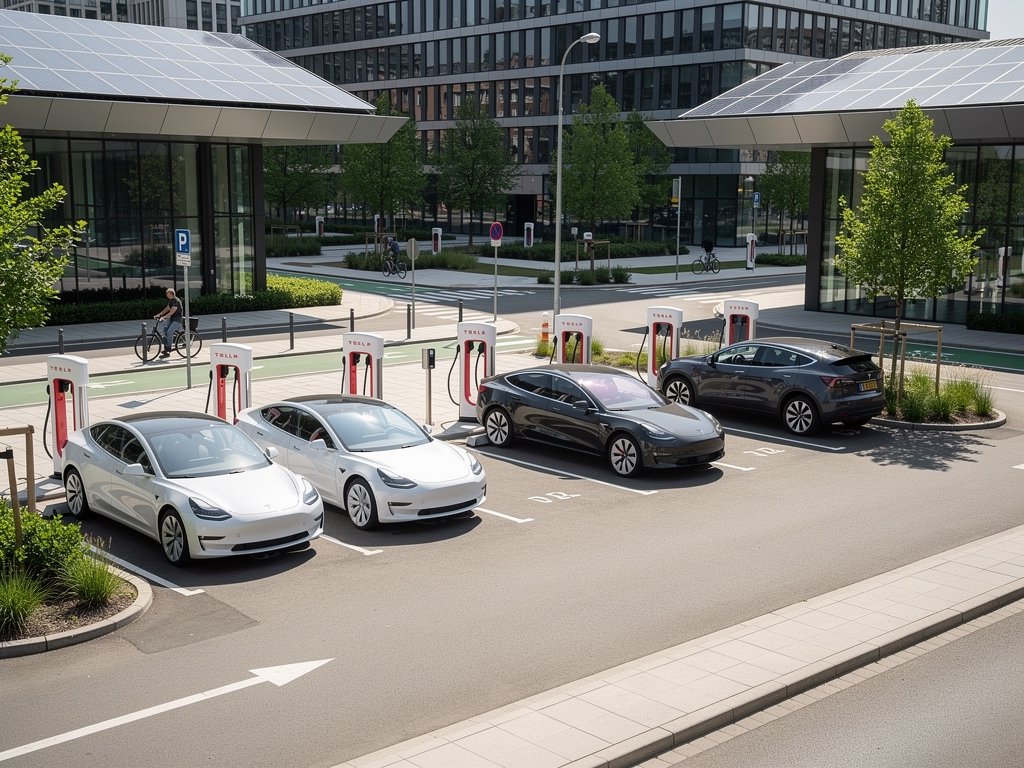
What Tesla Launched
Tesla has released an online calculator for its Supercharger for Business programme, giving property owners the first transparent look at what it actually costs to install and operate a Supercharger station. The tool, announced with Tesla's note that "simplicity and transparency" have been a problem in the charging industry, lets any business enter an address and receive a detailed cost and revenue model.
The Numbers
A standard 8-stall V4 Supercharger site runs approximately $500,000 in hardware, with installation adding roughly $55,000 per post. The all-in cost for a typical site comes to just under $940,000.
| Metric | San Francisco | Miami Beach | Manhattan |
|---|---|---|---|
| All-in cost | ~$940,000 | ~$940,000 | ~$940,000 |
| Utilisation (kWh/post/day) | 449.6 | 453.4 | ~300 |
| Retail price ($/kWh) | $0.59 | ~$0.45 | ~$0.50 |
| Estimated payback | 4 years | ~4.5 years | 7 years |
Tesla charges a flat $0.10 per kWh fee to cover software, billing, and network operations. Businesses set their own retail price and keep the margin above that fee. Over a 15-year period, top-performing locations can generate multi-million-dollar cumulative revenue.
Why the ROI Gap Matters
The calculator exposes a dramatic gap between the best and worst locations. San Francisco leads despite having the second-highest electricity costs in the sample — Tesla's fleet data shows its downtown sites push nearly 450 kWh per post per day and command the highest retail price at $0.59/kWh. Miami Beach nearly matches on utilisation while paying significantly less for power.
Manhattan, by contrast, shows a 7-year payback due to lower utilisation and high real estate costs. The data makes clear that location selection is the single most important factor in Supercharger profitability.
European Implications
The calculator is currently US-only, but the transparency it provides has direct relevance for European markets. Tesla's V4 Supercharger rollout across Europe has been accelerating throughout 2025 and 2026, backed by €149 million in EU funding for 7,000 new charging points.
European energy prices, land costs, and utilisation patterns differ substantially from the US. A European version of this calculator would help property owners in high-traffic corridors — motorway service stations, shopping centres, hotel chains — evaluate whether hosting a Supercharger site makes financial sense.
Tesla currently operates over 14,000 charging points across Europe, with the V4 network expanding into the Baltics and Southern Europe. If the Supercharger for Business model scales across the Atlantic, it could significantly accelerate third-party site deployment in markets where Tesla's own buildout has been slower.