
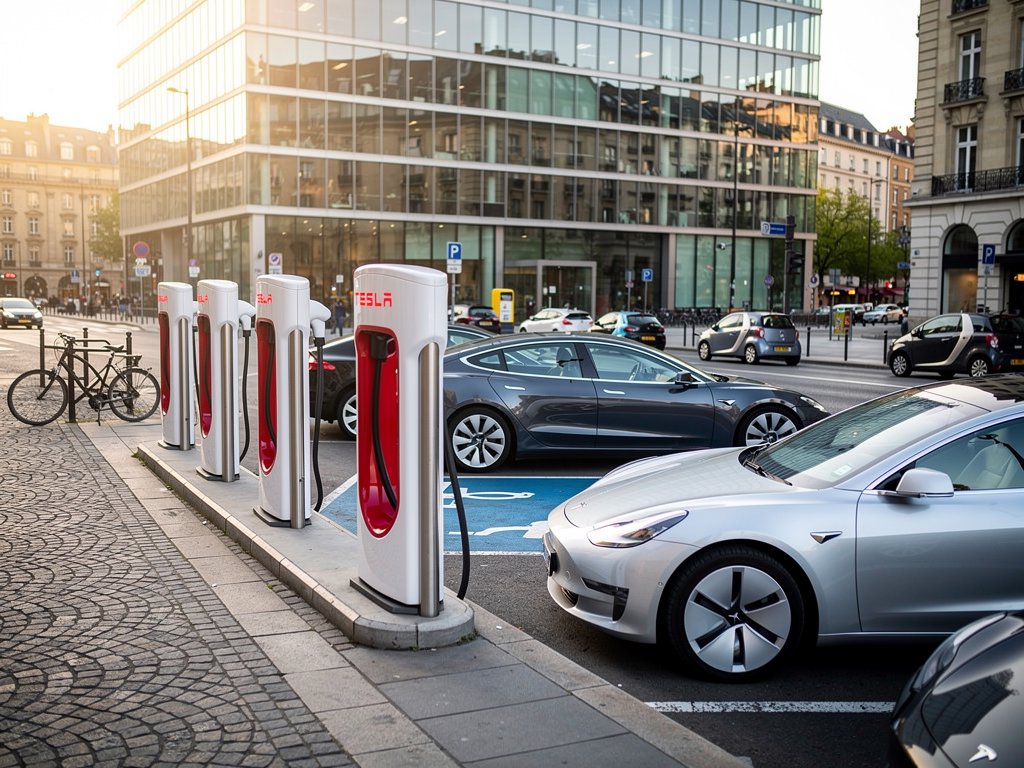
A Model Trained Inside the Geofence
Tesla has rolled out a new machine-learning model designed to predict how busy a Supercharger will be — not just at the moment a driver arrives, but several minutes ahead, based on which cars are moving toward the site. The model was trained on 9 million miles of anonymised, aggregated trajectory data collected exclusively inside the geofenced areas surrounding the global Supercharger network, according to disclosures cited by NotATeslaApp and Electrive.
The geofence-only training set matters: it filters out vehicles that pass through a Supercharger plaza without charging — pulling in for coffee, restrooms or to drop off passengers — and isolates real charging intent. That has historically been the hardest part of wait-time prediction, because mixed-purpose plaza traffic looked indistinguishable from charge-bound traffic in earlier models.
What the Numbers Look Like
Tesla reports the model reduces queue-estimate error rates by roughly 20 percent overall. At sites where 10 or more vehicles are queueing, predictions now sit within 1 to 2 cars of the actual queue length, according to release coverage. That is a useful threshold for real-world trip planning: the difference between a 10-minute wait and a 30-minute wait reshapes whether a driver stops at the next site down the corridor or pushes on.
The forecast also feeds the in-car navigation prompts. When the system anticipates a queue forming, it surfaces alternative nearby Superchargers earlier in the route, reducing the chance of multiple Tesla drivers arriving at the same congested site within the same five-minute window.
How It Connects to the Virtual Queue
The queue-prediction model is the back-end half of a two-part initiative. The other half is the Virtual Supercharger Queue feature that landed with Tesla app version 4.56 on 25 April 2026. The app gives drivers a geofenced waitlist they can join as they approach a busy site; the new ML model gives both Tesla and the driver a sharper estimate of how that wait will play out.
The two work together: the AI predicts congestion before the queue forms, and the app coordinates the queue once it does. Together they replace the ad-hoc lines that have appeared at busy corridor sites during peak holiday periods.
What It Means for European Drivers
For European owners the immediate beneficiaries are corridor sites under sustained pressure — Rygge, Ærø, Hilden, Junction 17 in the UK and the Tarn corridor in France being typical examples. Better forecasting reduces the chance of queue-related route detours during summer travel and EV-club weekend events.
The rollout is staged. Tesla is initially limiting the model to selected Supercharger locations while it analyses prediction accuracy site-by-site. There is no European launch date; the company has historically pushed routing improvements globally once the underlying model is stable.
Reading the Roadmap
The deeper signal in this release is how Tesla is using its fleet data. Nine million miles of trajectory information collected only inside Supercharger geofences is a narrow slice of the overall fleet log — but it is the slice that matters for charging logistics. It also illustrates the kind of operational ML problem Tesla can solve with vehicle telemetry that competitors lack: utilities and third-party charging networks see only the cars that plug in, not the cars approaching the site that may or may not stop.
For drivers, the practical change is small but welcome. Pull up to a familiar Supercharger after a long drive, glance at the navigation screen, and the wait-time number is now more likely to be the wait you actually get.