
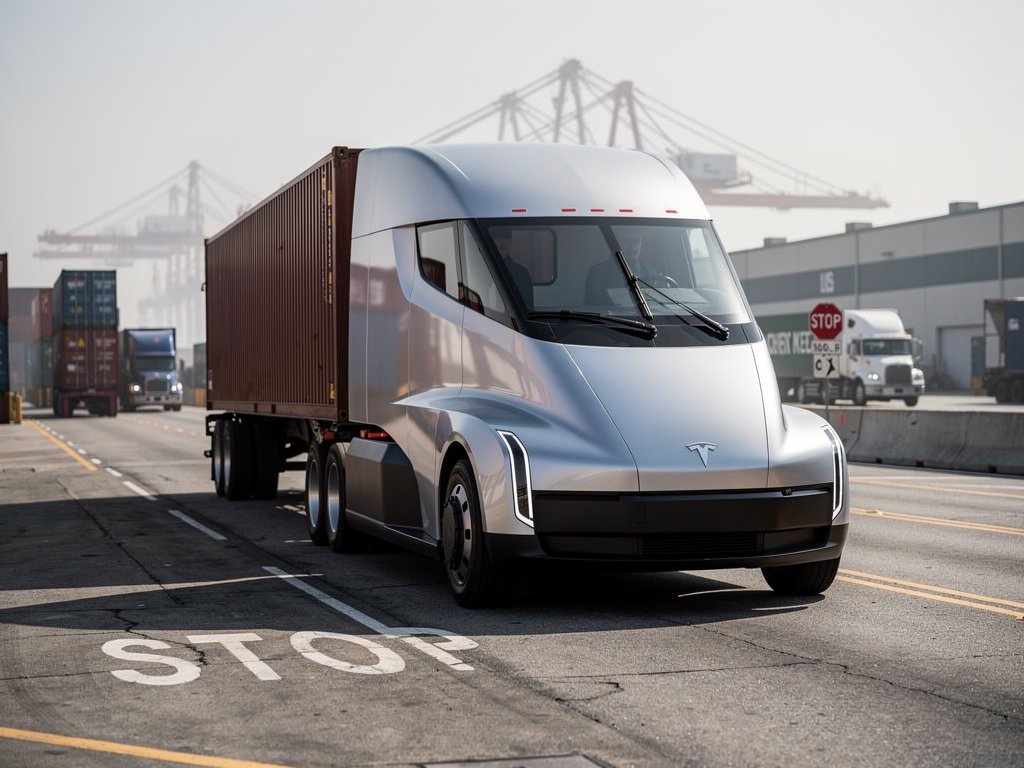
Tesla Semi has just landed its second port-drayage operator. MDB Transportation, a Southern California carrier based in Compton, started a three-week pilot on 29 April 2026 hauling containers between the Ports of Los Angeles and Long Beach and inland warehouses in the Inland Empire. The pilot was first reported by Electrek and confirmed by an MDB-issued press release the same morning. It comes on the heels of Tesla rolling its first high-volume Semi off the line at Gigafactory Nevada and underscores how the Class 8 segment most likely to electrify first is short-haul port work.
Why Port Drayage Is The Best-Case Scenario
Drayage is the short-distance trucking that moves containers from a port to a nearby warehouse, rail yard, or distribution centre. The duty cycle suits a battery-electric truck better than almost any other freight segment, for four reasons:
- Routes are short — typically 30 to 80 km from port to inland warehouse — well within the Tesla Semi's range without needing a midday charge
- Trucks return to a fixed depot every shift, where overnight or end-of-shift Megacharging is feasible
- Diesel fuel costs in Los Angeles ports run among the highest in the United States, making per-mile economics meaningfully better for an electric truck even at the Semi's roughly 290,000 US dollar Long Range price
- California Air Resources Board zero-emissions rules and the Ports of Los Angeles and Long Beach Clean Air Action Plan are pushing operators toward electric trucks on tight timelines
The MDB pilot is the second active port-drayage trial after Long Beach-based Hight Logistics took its first Semi earlier in 2026 and is now expanding its fleet, according to coverage from Electrek and Drive Tesla Canada.
What The Pilot Tracks
MDB's three-week run is structured to gather operating data rather than to scale immediately. The carrier has said it will track:
| Metric | Why it matters |
|---|---|
| kWh per loaded mile | Real-world drayage efficiency vs. Tesla's published figures |
| Charging cycle time at Megacharger | Whether the duty cycle works without operational gaps |
| Driver experience over multi-shift days | Cab ergonomics and feature use during stop-and-go port queueing |
| Total cost of operation per shift | Direct comparison against MDB's diesel fleet baseline |
MDB has not announced a follow-on order. Per Electrek, a positive pilot result is more likely to produce a phased fleet conversion than a single bulk purchase.
Charging Infrastructure Is The Constraint
The pilot is feasible because Tesla opened its first publicly accessible Megacharger station in Ontario, California in March 2026, in the heart of the Inland Empire freight corridor that MDB serves. Tesla has mapped 66 Megacharger locations across 15 US states, with the first Pilot truck-stop sites scheduled to open in the summer of 2026. For Semi customers without depot charging, Megacharger access on a working corridor is the difference between operational and parked.
Why This Matters For Europe
For European fleet operators watching the Semi from across the Atlantic, the MDB pilot is a useful data point on three questions European drayage operators face directly:
- Whether the Semi's claimed range and charging cycle hold up under realistic port-drayage stop-and-go conditions
- Whether driver experience at sustained shift length is competitive with diesel
- Whether the per-shift economics close the gap with diesel without subsidy
EU operators won't have the option to order the truck this year. Tesla has not type-approved the Semi for European cab dimensions, and the truck does not currently meet EU direct-vision standards. But the European market for short-haul port drayage — Rotterdam, Antwerp, Hamburg, Marseille, Algeciras, Piraeus — is conceptually the same business and is where any future European Semi launch would likely begin. Real numbers from the MDB pilot will inform what European fleet directors expect when Tesla finally crosses the Atlantic.