
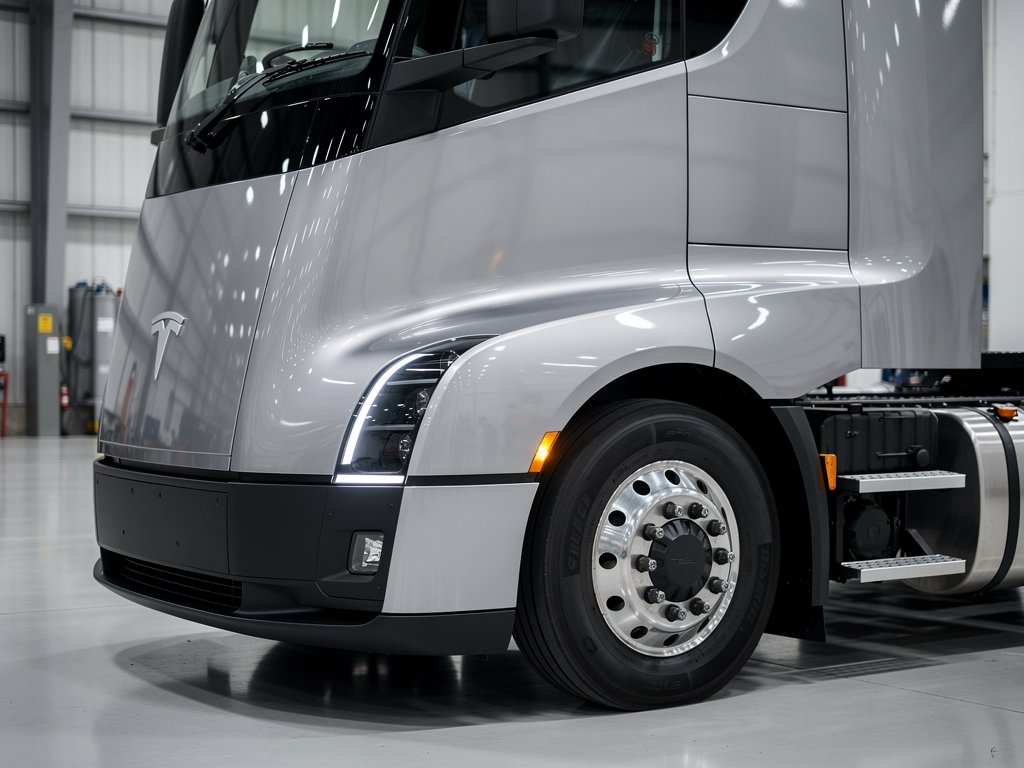
Tesla has begun mass production of the Semi truck. On 29 April 2026 the first unit rolled off the new high-volume line at the dedicated Semi factory next to Gigafactory Nevada, with Tesla sharing an image of the truck from its official Tesla Semi account on X. After several years of small pilot builds delivered to Pepsi and a handful of other customers, the program has moved into industrial-scale assembly at a 1.7 million square foot facility designed for an annual capacity of 50,000 trucks.
What changed on 29 April
The milestone marks the transition from limited hand-built units to series production. Tesla had been building Semis at very low volumes since the December 2022 first deliveries, primarily for testing and select fleet customers. The new dedicated factory, announced in 2023 and built up through 2024 and 2025, was completed and tooled during early 2026. Production will ramp gradually rather than reach full capacity immediately.
Specifications and pricing
Tesla published the final production specifications in February 2026, confirming two trims:
| Trim | Range | GCW | Price |
|---|---|---|---|
| Standard Range | 325 miles (~520 km) | 82,000 lb | ~$260,000 |
| Long Range | 500 miles (~800 km) | 82,000 lb | ~$290,000 |
Both variants use a three-motor rear-axle layout with up to 800 kW peak output and support 1.2 MW Megacharger fast charging. The Standard Range is aimed at regional freight cycles where overnight depot charging is sufficient; the Long Range targets longer hauls with mid-shift Megacharger top-ups.
Demand and delivery outlook
In California's Clean Truck and Bus Voucher program, the Tesla Semi accounted for 965 of 1,067 applications between January 2025 and February 2026, indicating strong commercial interest in the United States. Tesla has not announced a European market launch and the truck does not currently meet EU type-approval requirements for cab dimensions and direct-vision standards. Any European introduction would require either a re-engineered cab or a regulatory carve-out, neither of which has been signalled by Tesla so far.
The near-term focus will be on US fleet customers including Pepsi, Sysco, Saia, and several food and beverage distributors that already operate pilot units. Tesla has not yet shared a 2026 production target, but has previously said it expects to clear 50,000 units annually once the line is fully ramped.
Why this matters for Europe
For European fleet operators, mass production is the prerequisite for any future imports through the grey market or fleet-conversion route, and it materially de-risks the Megacharger network rollout that Tesla has begun in California. It also gives engineers and component suppliers the data needed to evaluate whether a future EU-compliant Semi variant — likely with a different cab — is viable. For now, European haulage operators looking at battery-electric Class 8 alternatives will continue to compare Volvo FH Electric, Mercedes-Benz eActros 600, MAN eTGX, and Renault Trucks E-Tech T against each other, with the Tesla Semi remaining a US-only product.