
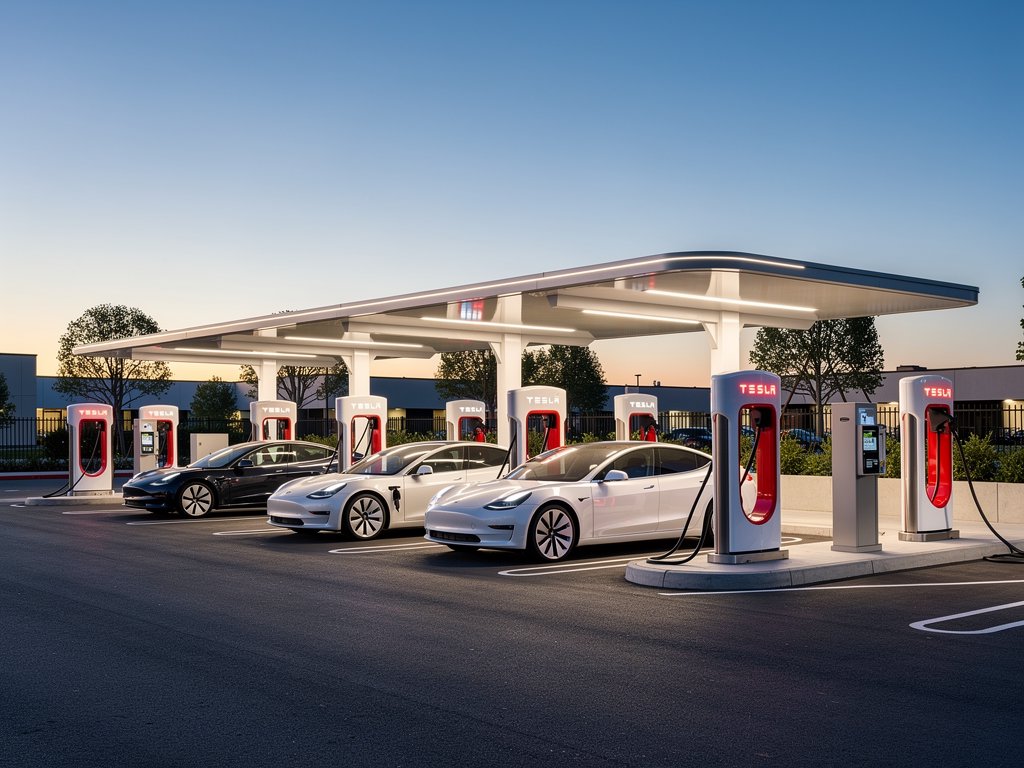
Tesla has filed a patent application for a self-locking charging adapter that mechanically secures itself to the vehicle inlet or the charging station, with the unlock mechanism inaccessible to anyone but an authorised user. The filing was first surfaced by Torque News on 13 May 2026 and describes a device designed for exactly the kind of multi-standard charging environment Europe and North America are now sliding into.
What the Patent Describes
The application covers an adapter body that can:
- Mate a NACS (J3400) charging cable to a CCS-equipped vehicle or vice versa
- Lock itself to the EVSE-side connector when in use, so it cannot be unplugged mid-session
- Lock itself to the vehicle-side inlet, so it cannot be removed by a passerby once the session ends
- Operate on both AC Level 2 and DC fast-charging power levels
- Hide the physical release behind authentication, so the legitimate user can free the adapter but a bystander cannot
The lock mechanism is the novel part. Most aftermarket third-party adapters today rely on a friction fit and the host vehicle's own connector lock, which is why an adapter left at a Supercharger can disappear in seconds when the car drives off. Tesla's patent puts the lock inside the adapter, where it stays engaged until the authenticated unlock signal is received.
Why Adapters Have Become a Problem
The NACS migration is creating a generation of EVs that need a permanent adapter to use the larger CCS public network in Europe — and CCS cars that need an adapter to use Tesla's Supercharger network where Magic Dock is not installed. Adapters left at busy charging sites have been stolen, swapped, damaged, or simply walked off with by mistake. Owner forums in the UK, Germany and France have documented dozens of cases over the past 12 months, with replacement adapters costing €150 to €400 depending on power class.
| Risk | Today's adapters | Patented self-locking adapter |
|---|---|---|
| Stolen from charging stall | Common — slips free with vehicle disconnect | Locked to inlet or dock; requires authentication |
| Disconnected mid-session | Possible — anyone can yank the cable | Mechanically retained at both ends |
| Damaged at site | Frequent — no protection against rough handling | Physically clamped, no leverage point |
What It Means in Europe
Europe's adapter problem is the mirror image of North America's. Where US Tesla owners need adapters to reach CCS chargers from companies like Electrify America, EU Tesla owners need adapters when they take their car to non-Magic-Dock CCS sites — common across France, Spain and the Nordic regions. CCS-native cars from BMW, Volkswagen, Mercedes, Hyundai and Kia increasingly arrive in 2026 with NACS adapters bundled, since the Tesla Supercharger network has been steadily opening to other brands across the continent.
A self-locking adapter solves the practical problem of leaving a €300 piece of equipment behind at a busy motorway charger. If Tesla shipped this design as a standard accessory, it would also reduce the friction that has slowed cross-brand Supercharger uptake — non-Tesla EV drivers would no longer have to think about adapter security as part of every charging stop.
What It Does Not Mean Yet
A patent application is not a product. Tesla files dozens of patents each year that never reach production, and the filing does not say when or whether the adapter will appear at Superchargers, third-party stations, or as an aftermarket accessory. The company has also not announced pricing or regional availability. What the filing does signal is that Tesla sees the adapter-loss problem as serious enough to design a hardware fix — and that it intends to be the company supplying the fix.