
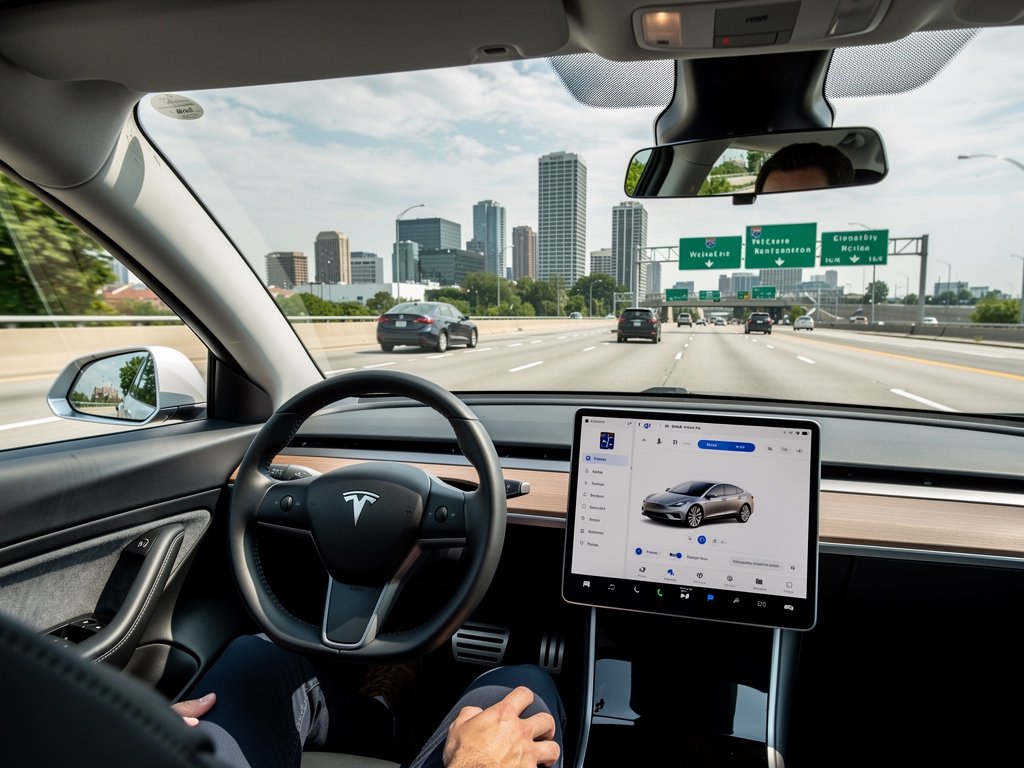
Tesla is throttling its Robotaxi expansion until the next major release of Full Self-Driving lands. According to job listings and statements summarised on 28 April 2026, the company is preparing smaller validation fleets in Florida, Nevada, and Arizona to learn local driving conditions, and will hold off on a wide commercial deployment until FSD v15 ships.
What Tesla is doing now
Tesla currently runs commercial Robotaxi services in Austin, the San Francisco Bay Area, Dallas, and Houston — the latter two added in April 2026 with unsupervised operation. Beyond those launch markets, Tesla has published Robotaxi operator and deployment-engineer job postings in Florida, Nevada, and Arizona. Industry reporting describes these as validation fleets rather than full commercial launches: small numbers of vehicles operated by Tesla staff to gather telemetry on local roads, weather, and traffic patterns ahead of customer-facing service.
The stated plan is to operate Robotaxi services in seven cities by end of June 2026 — Dallas, Houston, Phoenix, Miami, Orlando, Tampa, and Las Vegas — but the bulk of those will start as supervised or limited-fleet pilots rather than full commercial rollouts.
Why FSD v15 is the trigger
FSD v15 is described as a full architectural overhaul rather than an incremental release. Tesla has signalled a target of late 2026 or early 2027 for v15, which would gate any Robotaxi scale-up to that timeline. The current public branch, FSD v14.3.2 (firmware 2026.2.9.8/2026.2.9.9), unifies the FSD model used in customer cars and Robotaxi vehicles for the first time, but Tesla and outside observers consider it a stepping stone rather than the architecture intended for fleet-scale autonomy.
Separately, Elon Musk confirmed on the Q1 2026 earnings call that Hardware 3 vehicles will not be capable of unsupervised FSD. Robotaxi service is therefore a HW4-and-up product, and any v15-enabled scale-up will exclude the legacy fleet.
What it means for Europe
No Robotaxi service is planned for Europe yet, and no European city is on Tesla's seven-city list. The relevant signal for European owners is the FSD v15 timeline itself: every major architectural step in the United States feeds back into the European supervised-FSD product, which received its first national approval in the Netherlands in April 2026 under UN Regulation R171. Italy and Spain are now also pushing for fast-track approvals, and Sweden's Strängnäs municipality has approved local FSD testing.
If v15 lands in late 2026, the European supervised version is likely to follow within several months, with the same architectural improvements (and the same HW3 cut-off). Owners considering FSD subscriptions in Europe should treat the v14 branch as the current reference point rather than waiting for v15 in their order or upgrade decisions.
What to watch next
- Whether the validation fleets in FL, NV, and AZ convert into customer-facing service before v15 ships
- A specific public timeline for FSD v15 (so far Tesla has given a target window, not a date)
- How Tesla phases European supervised FSD rollouts after Netherlands, particularly Germany (KBA) and France
- Hardware-trade-in pricing for HW3 owners who want to migrate to a v15-eligible car