
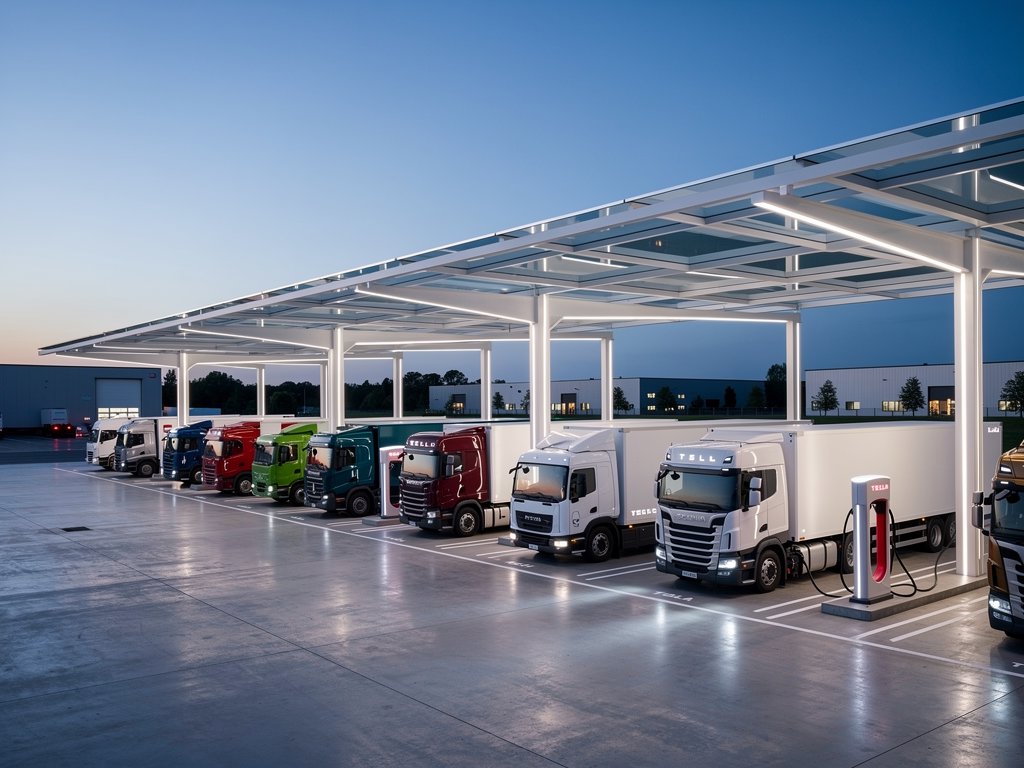
What Tesla announced
On 1 May 2026 Tesla launched Basecharger, a depot-class fast charger pitched at trucking fleets and large commercial sites, and revealed list pricing for its existing Megacharger at $188,000 per stall before installation. The combined product line is being marketed as a network — not just for Tesla Semi, but for any heavy-goods vehicle running the Megawatt Charging System (MCS) connector. Both products use MCS 3.2 and openly support the OCPI roaming protocol and ISO 15118-2, which are the same standards Mercedes, Volvo and MAN are building their European HGV charging plans around.
This is the explicit shift in posture: until now, Tesla's truck-charging hardware was Semi-only. The 1 May announcements reframe Megacharger as competitive infrastructure that any electric HGV fleet can pay to use.
What's new for European fleets
European trucking is where this matters most. Tesla already operates Megacharger sites in Germany and the Netherlands as part of the Semi homologation program, and is hiring a Munich-based commercial-charging business development lead to close fleet deals across the EU. The German and Dutch sites have been physically capable of charging non-Tesla MCS trucks for some time; what changed on 1 May was the commercial willingness — Tesla is now actively selling that capacity to third-party operators.
| Product | Peak power | Connector | Network access | Indicative price (US) |
|---|---|---|---|---|
| Megacharger | 1.2 MW | MCS 3.2 | Open to non-Tesla HGVs | $188,000 per stall |
| Basecharger | ~750 kW | MCS 3.2 | Depot deployment | Not disclosed |
For European fleet operators that have spent two years debating whether to build their own MCS infrastructure or wait for one of the trans-EU networks (Milence, IONITY-derived joint ventures, Pilot's planned partnership with Tesla) to mature, Tesla now offers a third option: pay for the existing capacity at Megacharger sites that are already in the ground.
Why it matters
The European Class 8 electric truck market is small but growing fast — Mercedes eActros 600, Volvo FH Electric and MAN eTGX are all in customer hands, and the MCS rollout is the bottleneck. By committing to MCS 3.2, OCPI and ISO 15118-2, Tesla is signalling that it does not intend to repeat the proprietary-connector mistake that delayed Supercharger interoperability in Europe by half a decade. Roaming through OCPI means a Volvo or MAN driver can plug into a Megacharger and pay through their existing fleet contract without a separate Tesla account.
For Tesla itself the move is a hedge: the Semi has not yet entered European deliveries, but Megacharger as a paid network can earn revenue even before a single Semi is registered in the EU. For European operators it removes a real adoption barrier — there is now a charging counterparty that will sell capacity today rather than promise it for 2027.
What we still don't know
Tesla has not disclosed Basecharger pricing, and the EU rollout map for the open Megacharger network is not yet public. The Munich BD role is the most concrete signal of how aggressively Tesla intends to monetise this — expect specific country deals, particularly in Germany and the Nordics where electric HGV regulatory pressure is highest, in the second half of 2026.