
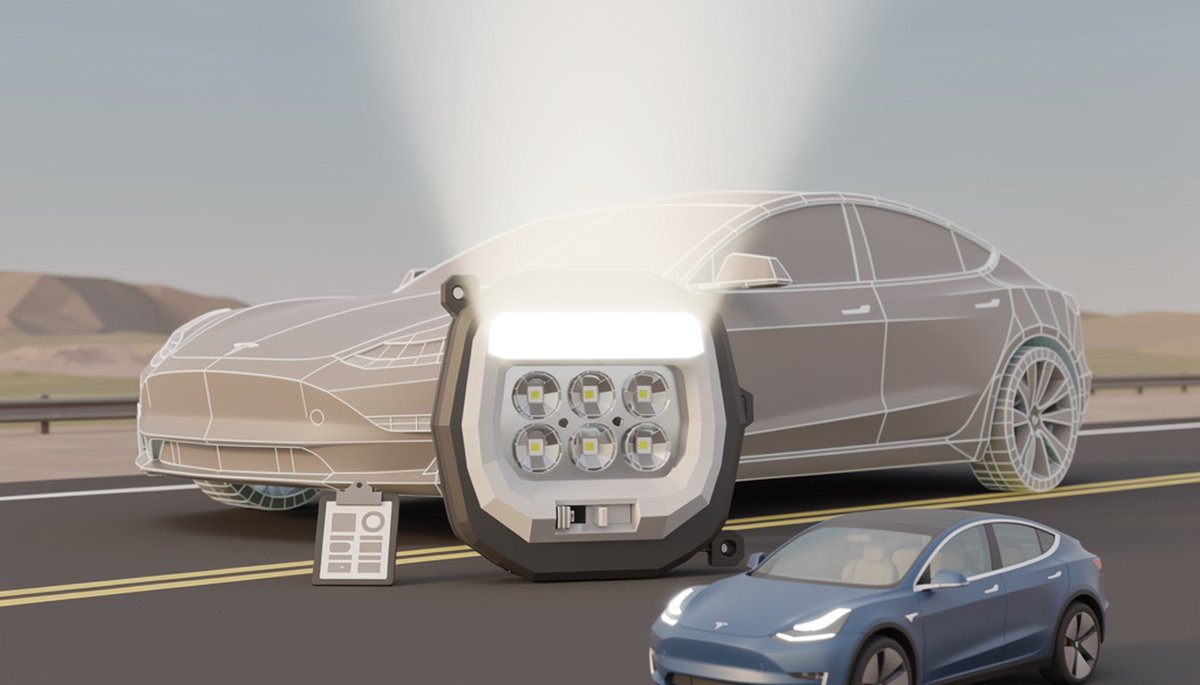
Tesla's attempt to sidestep a headlight recall has failed. The US National Highway Traffic Safety Administration (NHTSA) has denied the company's petition for an inconsequentiality exemption, obligating Tesla to notify affected owners and provide a free remedy. The decision covers roughly 19,917 Model 3 and Model Y vehicles built between 2017 and 2023.
The underlying defect
Tesla first filed a noncompliance report on 15 March 2024, disclosing that the low-beam headlights on the affected cars do not meet Federal Motor Vehicle Safety Standard (FMVSS) No. 108, the US rule governing lamps and reflective devices. Rather than remedy the issue straight away, Tesla petitioned NHTSA to declare the noncompliance "inconsequential as it relates to motor vehicle safety" — essentially arguing that the deviation posed no real-world risk and therefore did not warrant a recall.
Why the regulator disagreed
NHTSA rejected that reasoning. The agency concluded that Tesla had not met its burden of persuasion, and it specifically disputed the claim that there was no increased glare risk. In weather such as rain, snow, and fog, the regulator said, light from the noncompliant lamps "could result in light from the noncompliant lamps causing veiling glare to the driver or other road users driving" nearby. Because glare can reduce visibility for oncoming traffic, NHTSA determined the defect is consequential to safety and denied the exemption.
What owners can expect
With the petition denied, Tesla is now required to run a formal recall: notifying registered owners of the affected 2017–2023 Model 3 and Model Y cars and offering a free fix. Tesla has historically resolved many lighting- and software-related recalls through over-the-air updates, but a hardware-level lamp noncompliance may instead require a physical remedy or a lamp adjustment at a service centre. The recall paperwork will specify the exact procedure once it is issued.
The European angle
This is a US action under NHTSA jurisdiction and FMVSS No. 108, so it does not automatically extend to European cars. European lighting requirements are governed by separate UNECE regulations, and Tesla vehicles sold in Europe are homologated to those standards. Even so, the 2017–2023 Model 3 and Model Y share much of their hardware globally, so European owners of early cars may reasonably wonder whether their headlights are affected. Any European action would come through national type-approval authorities rather than NHTSA, and no such recall has been announced on this side of the Atlantic.
Context
The ruling lands during a period of heavy regulatory scrutiny of Tesla in the US, where NHTSA is also examining the camera-only Full Self-Driving system's behaviour in degraded visibility. The headlight case is narrower and older — a straightforward compliance matter dating back to a 2024 filing — but the denied petition is a reminder that regulators are increasingly unwilling to accept Tesla's own "inconsequential" assessments at face value.
Update: 2026-08-14
On 4 August 2026 Tesla filed the recall NHTSA had obliged it to run, registered as NHTSA campaign 26V507. The final count is 20,349 cars, slightly above the 19,917 estimated when the exemption petition was denied: 18,735 Model Y from 2020–2023 and 1,614 Model 3 from 2017–2023. The filing narrows the cause to headlamp assemblies carrying a supplier manufacturing date of 2 June 2023 or later, built by Marelli Automotive Lighting in Mexico — which is why cars repaired with those assemblies are included alongside cars built with them. The remedy is physical, as this article anticipated: a service-centre or mobile-service visit rather than an over-the-air fix, and Tesla says the exact repair is still being developed. Owner notification letters are scheduled to go out on 15 September 2026.
Update: 2026-10-01
NHTSA's record for campaign 26V507 now specifies the remedy this article and its August update left open: Tesla Service will replace the headlights, free of charge. The agency still flags the campaign as not an over-the-air fix, and owner notification letters have moved to 3 October 2026 from the 15 September date given when the recall was filed. Tesla's internal reference is SB-24-17-003. Separately, firmware 2026.38 began rolling out on 30 September carrying a Dynamic Headlight Leveling entry for legacy Model 3 and Model Y, and several outlets have presented that feature as the recall fix. It is not. It reaches only cars fitted with matrix LED headlights, and NHTSA's remedy for all 20,349 recalled vehicles remains a physical replacement. Sources: NHTSA recall 26V507000, Tesla update 2026.38 improves car visuals and adds auto-leveling headlights for legacy HW3 cars.