
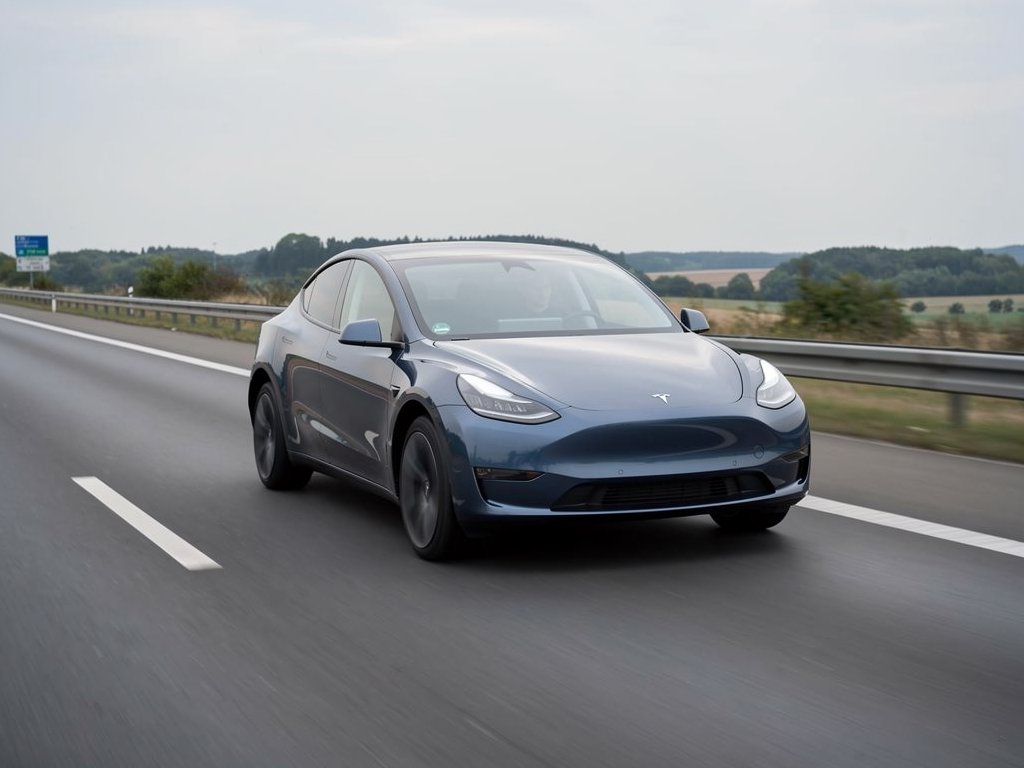
Tesla's Gigafactory Berlin-Brandenburg has quietly racked up 93,000 miles — about 150,000 kilometres — of Full Self-Driving operation on Model Ys leaving the production line, even though FSD remains unavailable to private German owners on public roads. Tesla AI lead Sawyer Merritt shared the milestone on 11 May 2026, alongside a Tesla Manufacturing video featuring General Assembly team member Jan describing the process.
How Factory FSD Works
Since October 2025, every Model Y that clears Giga Berlin's "Light Tunnel" — the final visual inspection station — engages FSD and drives itself out of the building. The route is not a straight line. Vehicles cross live factory traffic, stop at an on-site Supercharger for a pre-delivery top-up, and then park themselves in the outbound staging lot ready for transporters.
The environment is deliberately controlled: wide lanes, predictable layouts, minimal pedestrians and consistent lighting. That is what makes it legal under German rules — the entire route sits on Tesla's private property, so it falls outside the public-road approval regime that has so far blocked FSD for German owners.
Why 93,000 Miles Matter
The scale is not trivial. Giga Berlin averaged roughly 4,700 vehicles per week in Q1 2026 and has now built 750,000 cars in total since opening in 2022. Multiplied across that volume, autonomous staging removes a meaningful logistics task from the human workforce and gives Tesla a constant stream of real-world FSD telemetry from German roads, even if those roads are inside its own fence.
| Metric | Value |
|---|---|
| Cumulative FSD miles driven | 93,000 (≈150,000 km) |
| Start of routine factory FSD use | October 2025 |
| Average weekly output | ~4,700 vehicles (Q1 2026) |
| Total Model Ys built at Giga Berlin | 750,000 |
What It Says About FSD in Europe
EU-level approval for FSD Supervised has so far come only from the Netherlands, which cleared the system in April 2026. Germany's federal motor authority (KBA) has not yet signed off, and the Bundesrat is still negotiating the framework for higher levels of automation. Tesla's factory data does not change that, but it does give the company a fact-based talking point in the next regulatory round: the same software is already operating reliably on German soil, just on private ground.
For owners in Berlin, Munich or Hamburg, the practical outlook is unchanged — FSD on public roads still requires KBA approval. But the factory programme suggests Tesla is preparing the operational case for that approval, and is willing to show the data to regulators who ask.
What Happens Next
Tesla is in the middle of a 20% production ramp at Giga Berlin and plans to add 1,000 new workers this year, with 8 GWh of on-site battery capacity targeted by 2027. As output rises, the autonomous staging fleet will accumulate FSD mileage proportionally — and that data trail is exactly the kind of evidence European regulators have been asking Tesla to deliver before opening FSD to public traffic.