
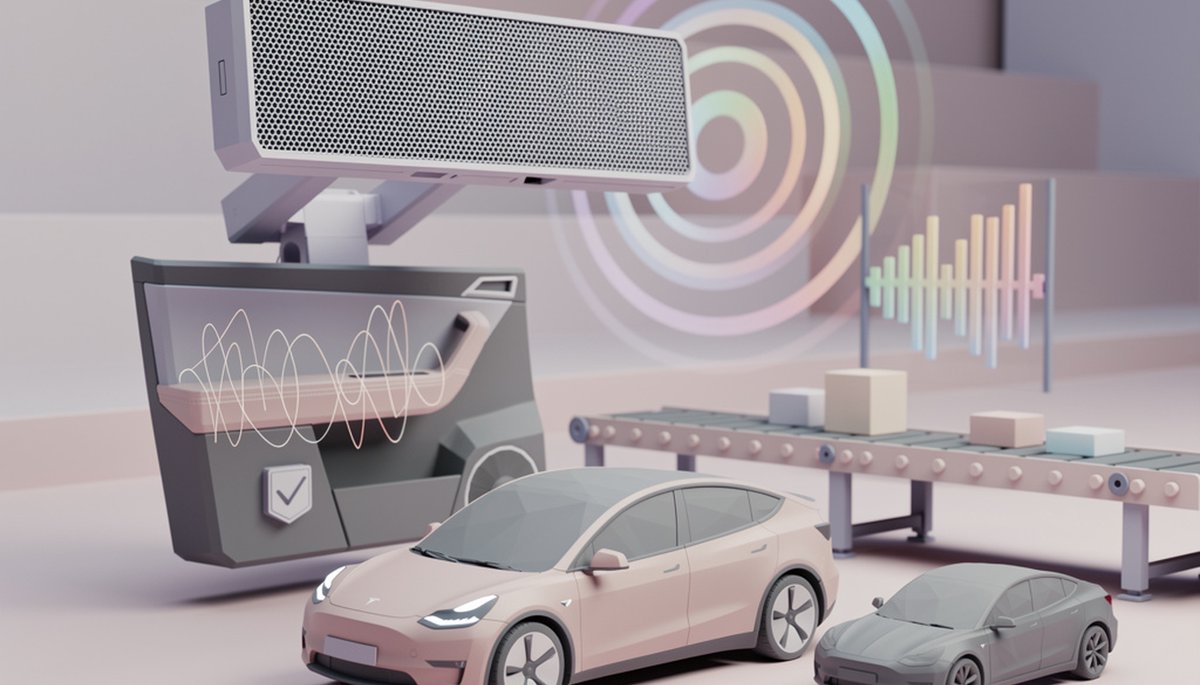
Tesla has found a novel use for hardware already sitting inside every car it builds: the interior microphones. During final factory checks, the company now uses a vehicle's own cabin microphones to listen for squeaks and rattles, catching build-quality faults on the line rather than leaving owners to discover them weeks later.
The car listens to itself
The approach was described by Lars Moravy, Tesla's Vice President of Engineering, who explained that the company is putting the in-cabin microphones to work as a quality-control instrument. As a car moves through end-of-line testing, the microphones capture the sounds the body and interior make under motion and vibration. Software then flags acoustic signatures that correspond to loose trim, panel gaps, or components rubbing against one another.
Because the sensors are already fitted for features like cabin noise cancellation and voice commands, Tesla adds the capability largely in software — no new hardware, no extra cost per car. It is the same philosophy behind Tesla using its external microphones and cameras for other diagnostics: reuse what the vehicle already carries.
Why squeaks and rattles matter
Interior squeaks and rattles are among the most common owner complaints for any modern car, and they have dogged Tesla in particular as it scaled production. They are also notoriously hard to reproduce — a rattle that appears on a specific road surface or temperature can elude a technician in the service bay. By capturing the acoustic fingerprint at the factory, Tesla can identify a problem car before it ships and, over time, feed the data back to spot which assembly steps or suppliers produce the most noise complaints.
A pattern of software-driven quality control
The microphone technique fits a broader shift in how Tesla approaches manufacturing. Rather than relying solely on human inspectors, the company increasingly instruments its cars to inspect themselves, using onboard sensors and machine analysis to standardize what used to be a subjective judgment call. That scales better across multiple factories and helps keep quality consistent between vehicles built in Fremont, Texas, Shanghai, and Berlin.
For European buyers, whose Model Y and Model 3 units come primarily from the Berlin-Brandenburg gigafactory, tighter end-of-line acoustic screening is a welcome sign. Build-quality consistency has been a recurring theme in European reviews, and a system that catches rattles before a car leaves the plant should reduce early service visits and improve the ownership experience from day one.