
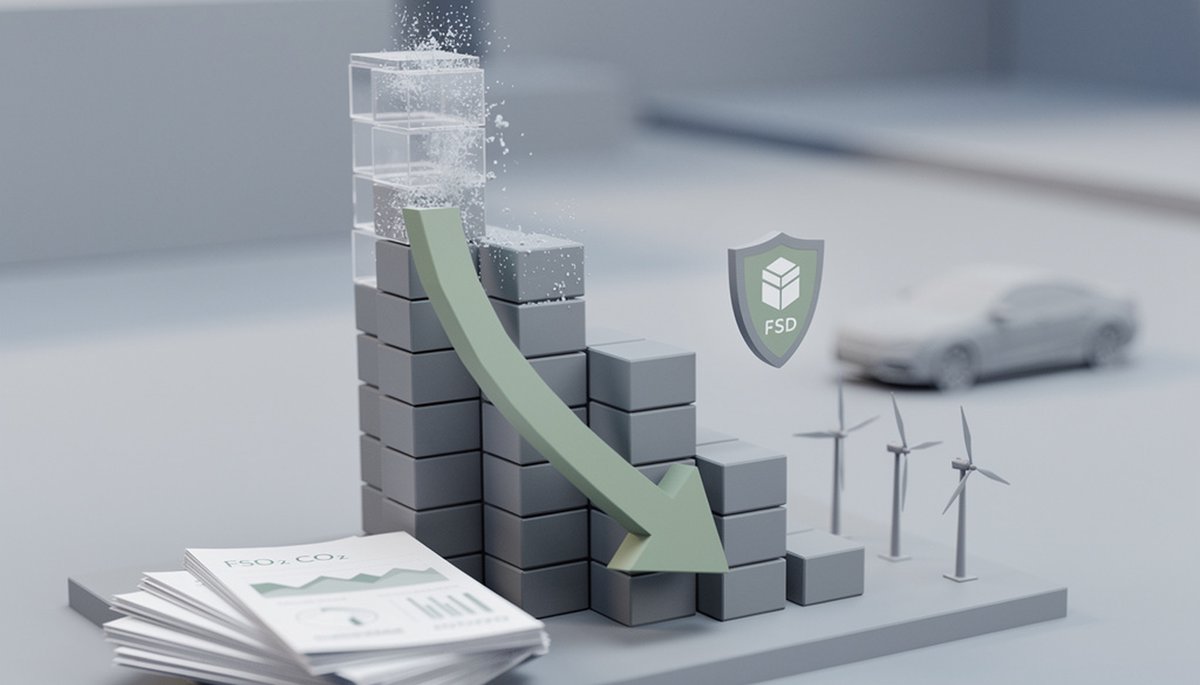
Tesla has published its 2025 Impact Report, a 216-page document the company frames around a theme of "amazing abundance." Beyond the marketing language, the report is the closest thing Tesla offers to an annual sustainability and safety audit — and this year it lands with a handful of concrete figures that matter to European owners as much as anyone.
A record year for avoided emissions
Tesla says its customers collectively kept 37 million metric tons of CO₂e out of the atmosphere in 2025, which the company equates to the annual energy use of roughly 5 million homes. That is about a 16% increase on the 32 million metric tons it reported for 2024, reflecting a larger fleet on the road and more of it charged on increasingly clean grids.
| Metric | 2024 | 2025 |
|---|---|---|
| CO₂e avoided by customers | 32M metric tons | 37M metric tons |
| Jobs created globally | — | ~135,000 |
| ASTM injury rate (2021: 3.6) | — | 2.3 |
Tesla also ranked first in Lead the Charge's 2025 supply-chain sustainability ranking for the second year running, ahead of Ford, Volvo, Mercedes-Benz and Volkswagen — a result that carries some weight in Europe, where three of those four rivals are based.
Fleet safety, with caveats
The report puts numbers on FSD (Supervised) safety. Tesla says drivers travel roughly 2.9 million miles between major collisions with FSD engaged globally — and around 5 million miles in North America — against an NHTSA baseline of about 505,000 miles per major collision for all US drivers. On a sample of 65 million miles, it found FSD-engaged trips used about 5% less energy than the same distance driven manually.
Those headline gaps are large, but they deserve scrutiny. Independent analysts have flagged that Tesla drivers may not be representative of the general population, may drive in lower-risk conditions, and that non-highway crashes can be under-counted — all of which inflate the comparison. It is a genuine improvement, not the 6× miracle the raw ratio suggests, and European owners should note that FSD (Supervised) remains far more limited here than in North America.
Jobs, injuries and the workforce
Tesla says it had created nearly 135,000 jobs globally by the end of 2025, and that its ASTM-standard injury rate fell from 3.6 in 2021 to 2.3 in 2025 — a meaningful move for a company that has faced repeated scrutiny over factory safety, including at Giga Berlin.
What it means for European owners
For drivers in Europe, the report is less a shopping guide than a scorecard. The emissions and supply-chain numbers are the strongest part of the story; the FSD safety claims are the part to read with a critical eye until regulators here see comparable data. The full report is available on Tesla's Impact page.
Update: 2026-07-08
One part of the 2025 Impact Report speaks directly to a common owner worry: how long the batteries last. Tesla reports that Model 3 and Model Y Long Range packs retain about 85% of their original capacity after 200,000 miles (roughly 320,000 km) — around 15% degradation over a distance few cars will ever reach. Model S and Model X fare slightly better at about 88% retention (12% loss). Crucially, the wear is not linear: most of the first 10% typically occurs within the initial 60,000–80,000 miles as the battery-management system calibrates, after which the rate settles to a gentle 1–2% per year. For European owners weighing long-term value and used-car prices, it is among the report's most reassuring figures, as detailed in Tesla's battery-retention data.
Update: 2026-07-09
The same 2025 Impact Report also records a 20% year-on-year increase in Tesla's battery recycling. Tesla says it recovered more than 14,000 metric tons of battery material in 2025 — equivalent to roughly 46,000 long-range packs — through a combination of in-house processing at its Gigafactories and third-party recycling partners. Its hydrometallurgical process recovers up to 98% of key metals such as nickel, cobalt and lithium, which are fed back into new cells and reduce the need for freshly mined material. For European buyers weighing the environmental case for going electric, the figure directly counters the persistent claim that worn-out EV batteries simply end up as waste, as detailed by Teslarati.
Update: 2026-07-10
The report also delivered the most concrete technical picture yet of the upcoming Cybercab. Tesla says the two-seat robotaxi's next-generation powertrain is expected to exceed 6.1 miles per kWh — more efficient than any Tesla on sale — and is engineered to avoid nearly twice the greenhouse-gas emissions per mile of the Model 3 and Model Y. The Cybercab pairs 4680 structural battery cells with steer-by-wire and a 48-volt electrical architecture that replaces the traditional 12-to-16-volt wiring, cutting copper, weight and complexity. Separately, Not a Tesla App reports — citing its own sources, so far unconfirmed by Tesla — that production Cybercabs carry dual GPS receivers for driverless-grade positioning and a more powerful FSD computer than today's Model 3 and Model Y.