
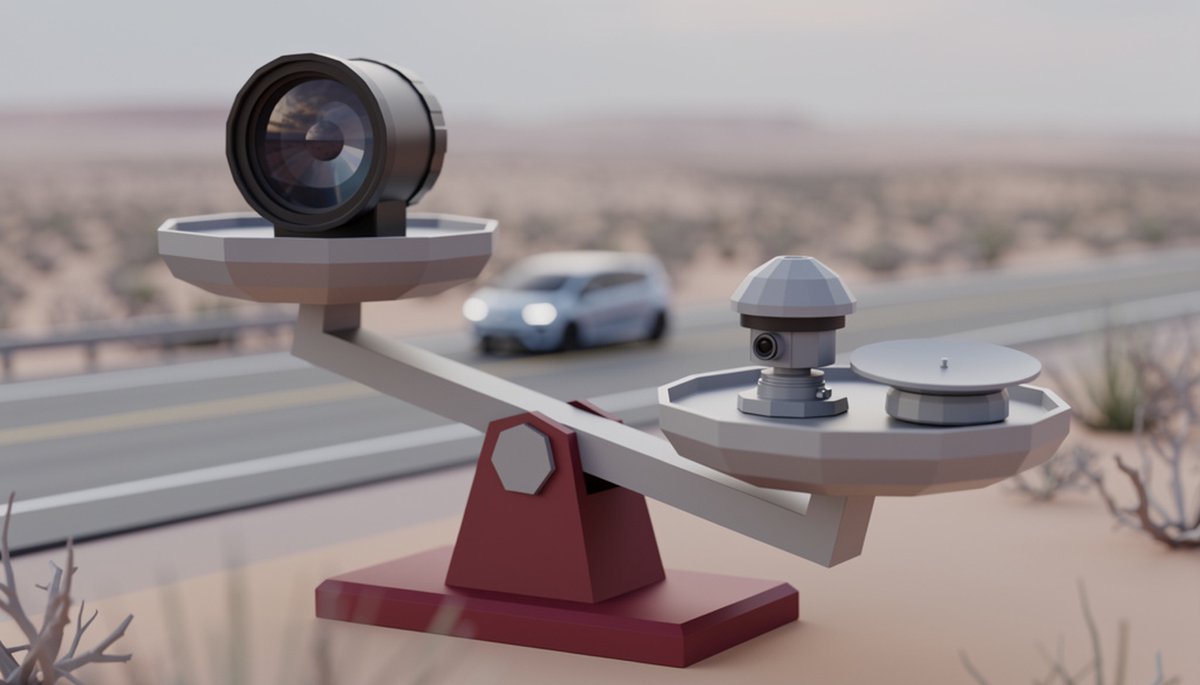
New Jersey lawmakers are advancing a bill that would set a sensor bar Tesla's Robotaxi cannot currently clear — a direct challenge to Elon Musk's long-held insistence that cameras alone are enough for autonomous driving.
What the bill requires
The measure, S1677 (with an Assembly companion, A3968), would create New Jersey's first fully autonomous-vehicle pilot: a three-year programme overseen by the state's Motor Vehicle Commission. To qualify, a driverless commercial vehicle would have to carry cameras plus two additional, distinct sensing technologies capable of detecting obstacles even if the cameras fail — in practice, radar and lidar. Operators would also need to complete 50,000 miles of supervised in-state testing before carrying passengers driverless.
Tesla's current hardware stack is cameras and nothing else. Under the proposed rules, that stack would not meet the eligibility threshold, so Tesla could not launch a camera-only Robotaxi service in the state unless it adds sensors or lawmakers amend the text. Waymo, whose vehicles already combine cameras, radar and lidar, would qualify — which is why the bill has been characterised as effectively singling out Tesla's approach rather than autonomy itself.
Where it stands
S1677 was introduced on 13 January 2026 and referred to the Senate Budget and Appropriations Committee on 11 May 2026. The Assembly version, A3968, has already cleared the Science, Innovation and Technology Committee. A floor vote is expected later this year. Tesla has begun urging New Jersey owners to contact legislators and oppose the bill, framing it as a barrier to technology its customers already use.
A wider pattern
New Jersey is not acting in isolation. A similar bill is pending in New York, and if both become law, the densely populated Northeast corridor would effectively close to camera-only robotaxis. That would force Tesla into a strategic choice: keep its vision-only architecture and cede those markets, or add the very sensors Musk has spent years arguing are unnecessary. Retrofitting lidar and radar is not a trivial software patch — it would mean new hardware, revalidation and cost that Tesla has deliberately engineered out of its cars, which is precisely why the company is fighting the bill rather than quietly complying.
Why European readers should watch
The fight is playing out in a US statehouse, but the underlying question — whether regulators will treat sensor redundancy as a legal precondition for driverless operation — is exactly the one Tesla faces as it seeks to expand Full Self-Driving and eventual robotaxi service across Europe. European type-approval and the UNECE framework already lean toward layered, fail-operational safety systems. A US precedent mandating lidar-plus-radar redundancy would strengthen the hand of any European regulator inclined to demand the same, making New Jersey's debate an early indicator of the headwinds Tesla's camera-only strategy could meet on this side of the Atlantic.