
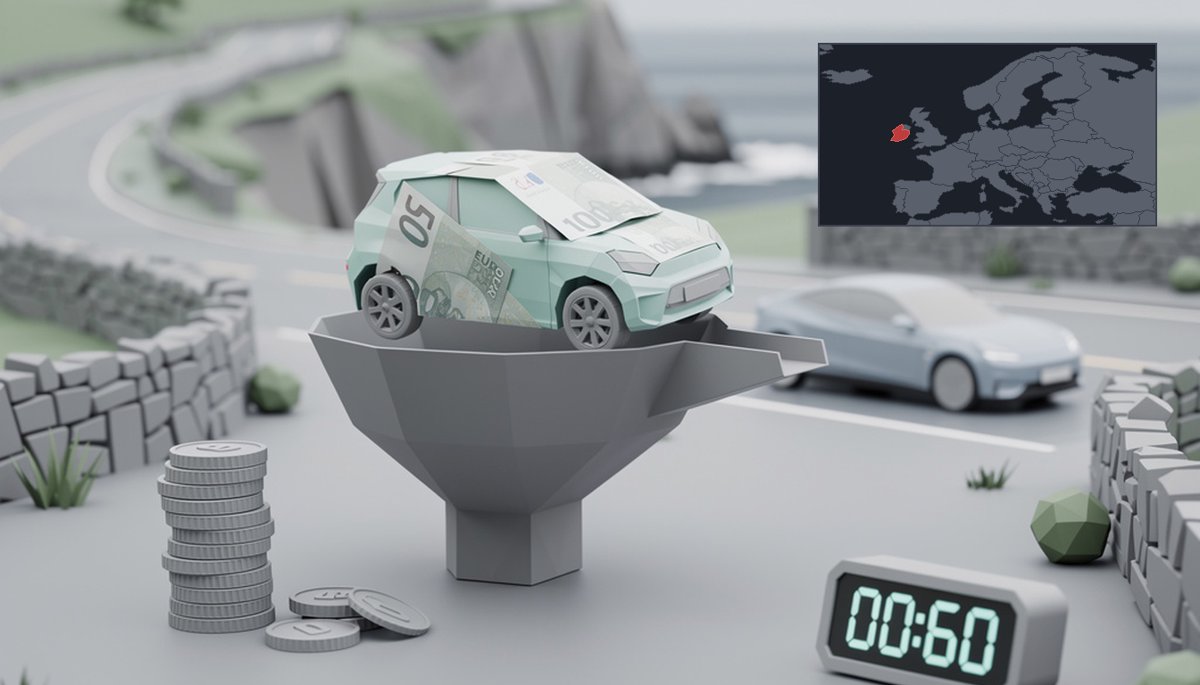
Ireland's newest electric-car incentive lasted barely an hour. The ICE2EV scrappage pilot opened for applications on 1 July 2026 and was fully subscribed within sixty minutes — the rural allocation exhausted in about 30 minutes — in a rush of demand that surprised even the government that designed it.
What the scheme offers
ICE2EV pays drivers to trade an old combustion car for a new electric one. The scrappage element is worth €5,000 toward a new battery-electric vehicle when an eligible petrol or diesel car is scrapped, and it stacks on top of the existing €3,500 SEAI purchase grant — a combined €8,500 off the price of a new EV.
The eligibility rules are deliberately tight. The car being scrapped must be a 2013 registration or older, and the applicant must have owned it for at least 12 months. The pilot was funded with a €10 million budget, split 65% for rural applicants and 35% for urban — a design meant to push adoption beyond the cities, which is exactly where it ran out fastest.
| Component | Amount |
|---|---|
| ICE2EV scrappage allowance | €5,000 |
| Existing SEAI purchase grant | €3,500 |
| Combined maximum | €8,500 |
Why the speed matters
A pilot that sells out in an hour is as much a signal as a subsidy. Roughly 2,000 applicants locked in grants before the funding was gone, and Transport Minister Darragh O'Brien said the government will assess the results before deciding how — or whether — to widen the scheme. Demand that strong is a hard argument to ignore when the next budget is written.
For Tesla, the relevance is direct. The €8,500 combined support brings a new EV within reach for buyers trading up from a decade-old car, and the Model 3 sits squarely in the price band these grants are designed to move. A larger follow-on scheme would put Tesla's cheapest models in front of exactly the mainstream, cost-conscious buyers Ireland is trying to convert.
The catch
The pilot's size was its limit. €10 million spread across up to €8,500 per car was only ever going to cover a few thousand vehicles, so the sell-out reflects scarcity as much as enthusiasm. The real test is whether Dublin follows a heavily oversubscribed trial with sustained, larger funding — or lets a popular pilot lapse.
What it means for Europe
Ireland is not alone in rethinking EV incentives. Several European governments have pulled or trimmed purchase subsidies over the past two years on cost grounds, and the results have been uneven — some markets stalled the moment support disappeared. A scrappage-linked grant that ties the subsidy to retiring an old, polluting car is a more targeted alternative, and Ireland has just produced a clean piece of evidence that the model shifts behaviour fast.
For European policymakers weighing how to revive EV demand without open-ended spending, an hour-long sell-out is a data point that travels well beyond Ireland — and for Tesla, every scheme that puts the Model 3 within reach of a mainstream buyer is one worth watching.