
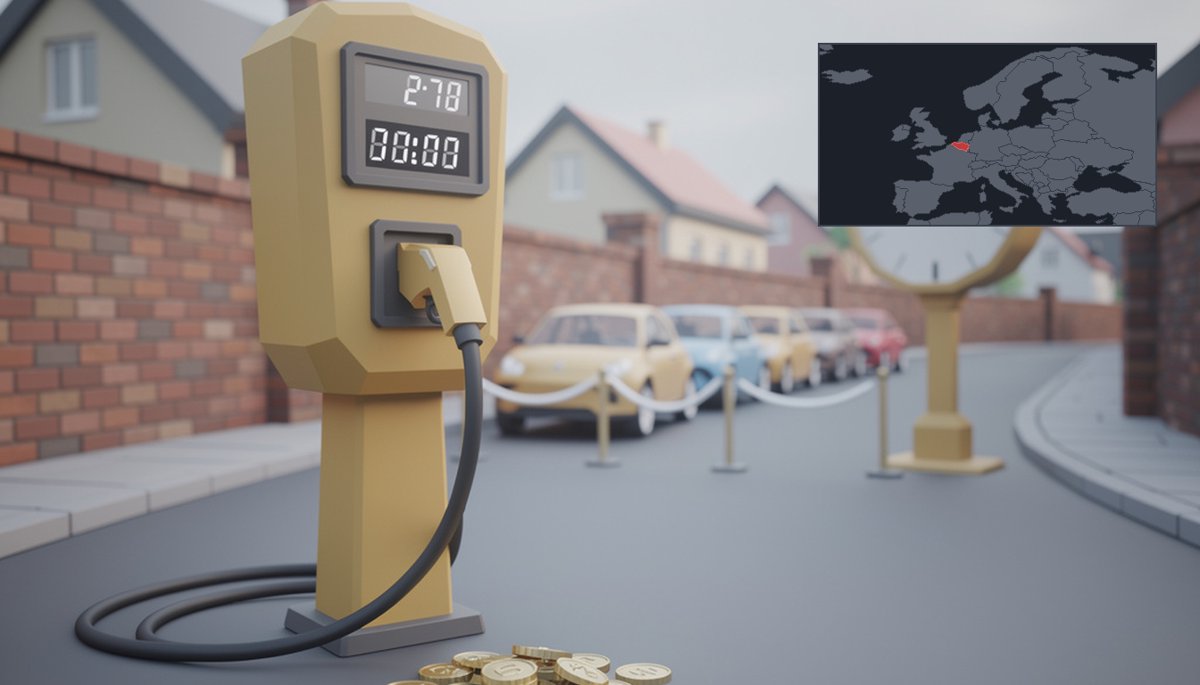
Leaving a fully charged EV parked on a public charger is about to get more expensive in the Belgian capital. From 1 October 2026, the Brussels-Capital Region introduces a rotation fee aimed at drivers who stay connected long after their car has finished charging — a growing problem as more EVs compete for the same public points.
How the rotation fee works
The principle is simple: once a charging session is complete, the connector should be freed for the next driver. The new fee separates charging from parking, so a car that keeps occupying a station after it is full starts accruing an occupancy charge — in some cases set higher than the ordinary parking rate to make the point.
Brussels is not inventing the idea. Antwerp introduced a rotation tariff first, and Ghent followed. In both cities the blocking rate is 6 cents per minute, and the meter only starts 30 minutes after the session ends — a grace period so drivers are not punished for a short delay in coming back to the car. The exact Brussels tariff falls to Sibelga and the region, but the mechanism is the same: keep the stalls turning over.
Why it matters for Tesla drivers
Tesla owners feel this from both sides. On third-party public chargers across Belgium, the fee is one more thing to watch — plug in, and plan to move the car promptly once it is done, especially on kerbside points where returning late now carries a cost.
It is also a policy Tesla itself pioneered. Superchargers have long charged idle fees to drivers who leave a car connected after charging completes, precisely to keep high-demand stalls available. Brussels is, in effect, extending that logic from a single network to the whole public charging estate — a sign that the idle-fee model is becoming a civic norm rather than an operator quirk.
Why it matters across Europe
The measure reflects a shift in how European cities think about charging. Early policy focused almost entirely on building more points; the newer concern is availability — making sure the points that exist are actually usable when you arrive. An occupied-but-idle charger generates no throughput and no revenue, so operators and municipalities across the EU increasingly treat lingering as the problem to solve rather than a minor annoyance.
Belgium is turning into a testbed for that idea, and it is spreading fast: Antwerp first, then Ghent, and now the capital. Other European cities with dense kerbside charging — from the Netherlands to Germany — face the same congestion pressure, so the Belgian template is likely to travel. For a European Tesla owner who charges in more than one country, idle penalties are becoming something to check wherever you plug in, not a local quirk.
For everyday drivers the practical takeaway is small but real: in Brussels from October, treat a public charger like a fuel pump, not a parking spot. Charge, then move on — or expect the meter to keep running.
Update: 2026-07-07
Reporting on 6 July 2026 pinned down the Brussels-specific terms the region had left open. The rotation fee is set at €0.06 per minute, and it only starts once a vehicle has been connected for more than six hours — and only between 09:00 and 22:00, so overnight charging is exempt. Regional grid operator Sibelga found that public points sit occupied for an average of six hours and 30 minutes, against a typical charging session of just two hours and 20 minutes. Brussels State Secretary for Energy Audrey Henry summed up the rationale: “Charging stations are not parking spaces.”