
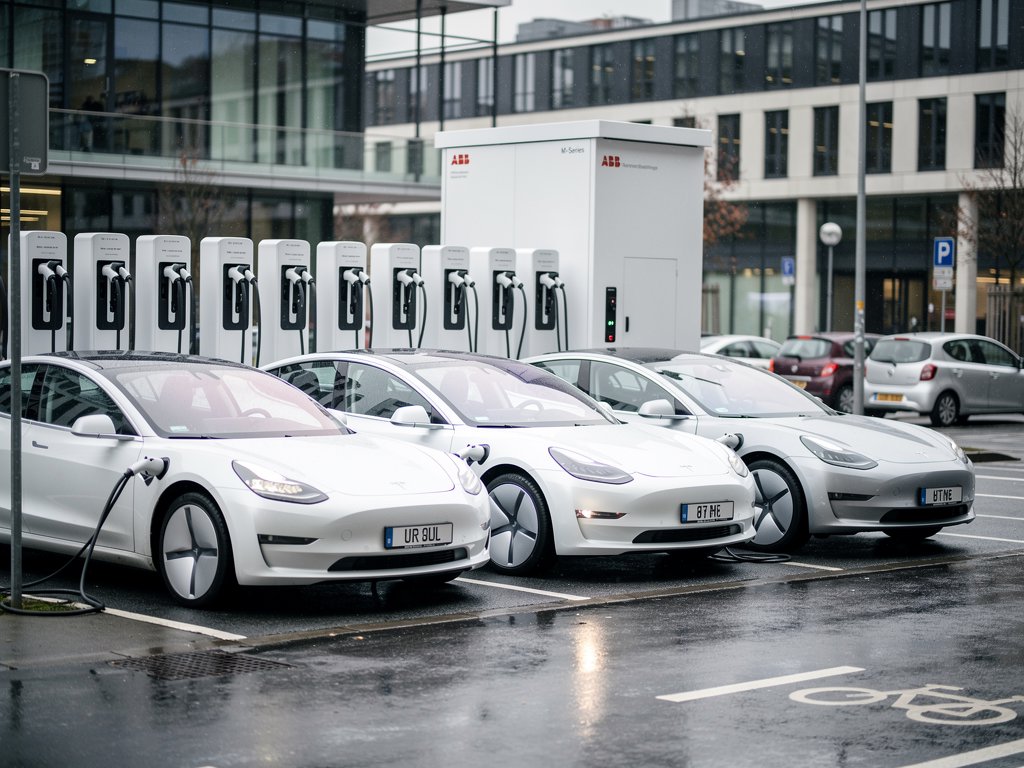
ABB E-mobility introduced its new M-Series modular fast-charging platform on 24 April 2026, a system designed to move European charging operators away from the peak-power arms race and toward higher delivered energy per square meter. For Tesla and other EV drivers in Europe, the launch matters because most of the public charging build-out in 2026 and 2027 will pass through ABB's hardware roadmap — the company supplies non-Tesla networks across the EU including Ionity, Allego, Fastned, Aral pulse and EnBW.
What's new
The M-Series separates power cabinets from the dispensers customers actually plug into, letting site operators add capacity without rebuilding electrical infrastructure. Power is pooled centrally and shared dynamically across active charging sessions instead of being locked to individual stalls. ABB's pitch is that this approach delivers more usable energy per hour at the site level than a wall of headline-rated 350 kW or 400 kW chargers that rarely run at peak.
Specifications at a glance
| Spec | M-Series |
|---|---|
| Power range | 200 kW – 1.2 MW |
| Charge points per system | Up to 24 |
| Expansion increment | 400 kW per cabinet (up to 3 cabinets) |
| Power density | 625 kW per square meter |
| Connectors supported | CCS1, CCS2, NACS, MCS |
| Layout configurations | 36 |
The MCS (Megawatt Charging System) connector support is notable — it's the same standard the Tesla Semi uses for 1.2 MW charging, and the M-Series is the first ABB product to ship with MCS as a standard option rather than a one-off project install.
Why it matters for European EV drivers
Three concrete reasons.
First, CCS2 is still the European default, and the M-Series's pooled-power architecture means a 30-stall site can be built for the realistic average load of a busy day rather than the worst-case scenario where all stalls run at peak. That should let operators stretch their grid connection further and bring sites online faster.
Second, NACS is now part of ABB's mainline Europe-aimed product. With several non-Tesla European networks committing to dual-standard sites for cross-compatibility with future Tesla vehicles, an ABB platform that ships NACS by default removes one excuse for delay.
Third, the 625 kW per square meter density matters for urban locations where space is the constraint. ChargePoint announced a competing standalone 600 kW unit on the same day, but ChargePoint's Express Solo is a fixed-power-per-stall design — closer to the previous-generation philosophy that ABB is now moving away from.
Where ABB sits versus Tesla Superchargers
Tesla's V4 Supercharger architecture in Europe currently delivers up to 350 kW per stall and supports CCS2 and NACS. Tesla is the only major European charging operator with full vertical integration from cell to dispenser, and the V4 rollout has continued to push price-per-kWh down. ABB's M-Series doesn't try to match Tesla's vertical economics — instead it gives third-party operators a platform that can stay competitive on cost-per-delivered-kWh as Tesla expands V4 to non-Tesla EVs.
ABB has not published European pricing or a country-by-country deployment plan. The first installations are expected at existing ABB partner networks across Germany, the Netherlands and the Nordics over the second half of 2026.