
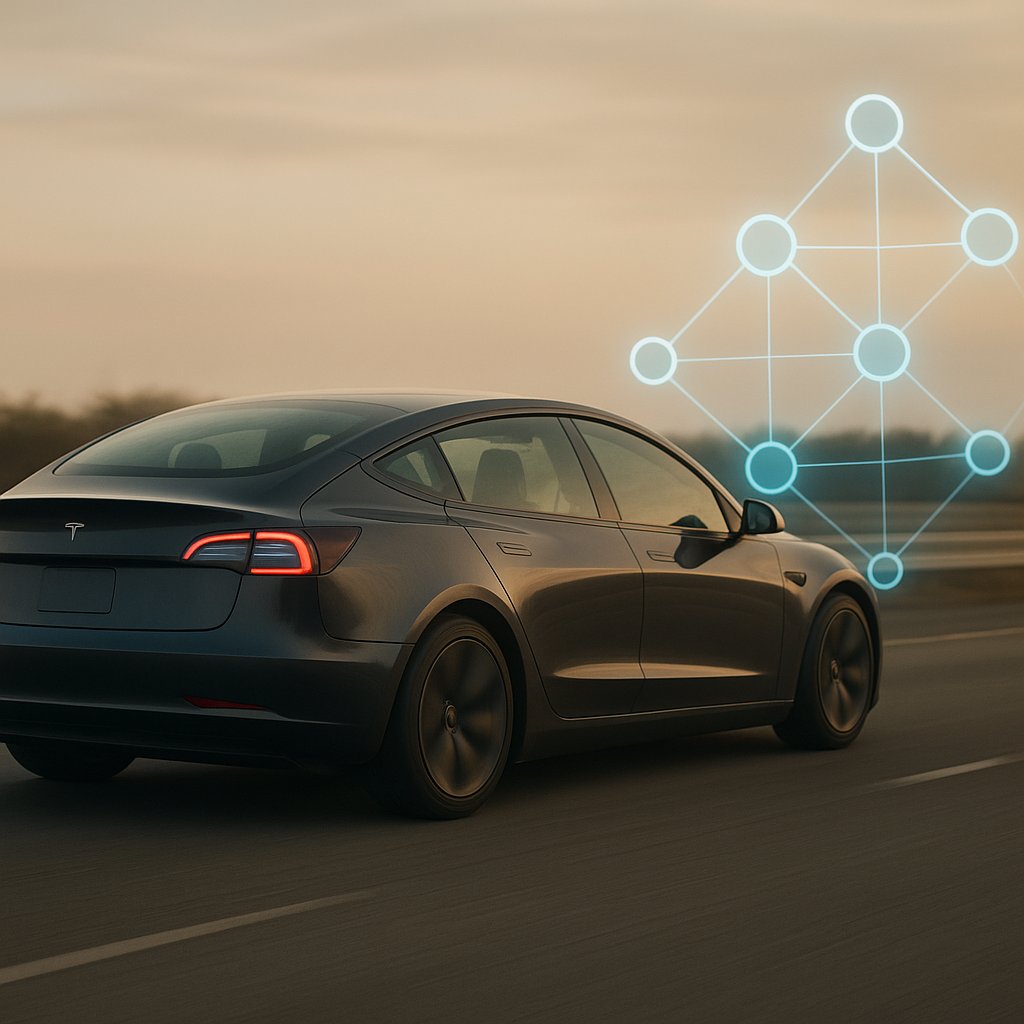
Tesla's filing US 2026/0105614 — "Artificial Intelligence Modeling Techniques for Joint Behavior Planning and Forecasting" — gives the clearest public picture yet of why Full Self-Driving v14 feels markedly more human than the previous v12 stack. It also implicitly sketches how Tesla plans to backport a usable version of that behaviour to the older HW3 ("AI3") computer as FSD v14-Lite.
A goal-first decision tree, not brute-force enumeration
The core idea is a hierarchical nodal graph. Instead of forecasting every possible future state of every nearby vehicle and pedestrian, the system starts with an explicit Goal Node — for example, "complete an unprotected left turn across two oncoming lanes." Around that goal, the planner spawns Interaction Nodes representing only the agents that actually matter to that goal: oncoming traffic in the relevant lanes, the pedestrian about to step off the curb, the cyclist at the intersection.
Every branch is scored. Bad branches — those that violate clearance, comfort, or legal constraints — are pruned aggressively and immediately. The planner never expands them. This is why v14 takes assertive but not reckless lines through complex junctions: it has spent its compute budget on the few options that actually plausibly work, instead of evaluating thousands of futures most of which were never realistic.
That's the architectural difference owners feel in the seat. The car commits earlier to a left turn, brakes later for a yielding pedestrian, and waits more confidently at a four-way stop, because the planner is reasoning about the relevant decision, not the entire scene.
v14-Lite: same logic, smaller model
The second half of the patent matters more for the long-suffering HW3 fleet. HW3 has roughly one-tenth the compute and a fraction of the memory of HW4. A literal port of the v14 model will not fit, let alone run in real time.
The filing describes three compression techniques that line up with what NotATeslaApp and Electrek have separately confirmed are being used for v14-Lite:
- Intelligent pruning of neural pathways that don't carry safety-critical signal. The model loses some of its long-tail edge-case handling but keeps the trunk that matters.
- 8-bit quantisation to shrink weights and activations, with "clever math" tricks to recover precision where the loss would otherwise matter. HW3 is fundamentally an 8-bit architecture, so this maps directly onto the hardware.
- Shorter temporal window — instead of holding the last ten seconds of scene context, the lite model holds three to five. That's still a major step up from v12, which was effectively memoryless, but it costs the model the kind of long-horizon foresight that lets HW4 cars anticipate two lane changes ahead.
The practical implication for HW3 owners is that v14-Lite will deliver the v14 behaviour — the smoother planning, the human-like yields and commits — at a slightly lower confidence level, with more conservative actions in scenes that exceed its shorter memory.
Why this matters for EU owners
Most Tesla vehicles delivered into Europe before mid-2023 ship with HW3. If FSD Supervised eventually clears EU regulatory approval, those cars need a path forward that doesn't require a hardware retrofit — Tesla has previously offered free HW3→HW4 upgrades only on a case-by-case basis, and the EU consumer-rights framework around such retrofits is unsettled.
A viable v14-Lite means the HW3 fleet does not become functionally obsolete the day FSD launches in Europe. It also means EU regulators get to evaluate a single behavioural model — v14 — across both hardware generations, rather than two divergent stacks. That alignment is easier to certify under UNECE driver-monitoring rules than a split fleet would be.
What the patent does not promise
A published patent describes a method that has been filed, not a behaviour that has been shipped. Tesla's actual release schedule for v14-Lite remains as previously communicated: a phased rollout to HW3 vehicles after the v14.3.x branch stabilises on HW4. The patent confirms the technical approach is real; the timing is still Tesla's to set.