
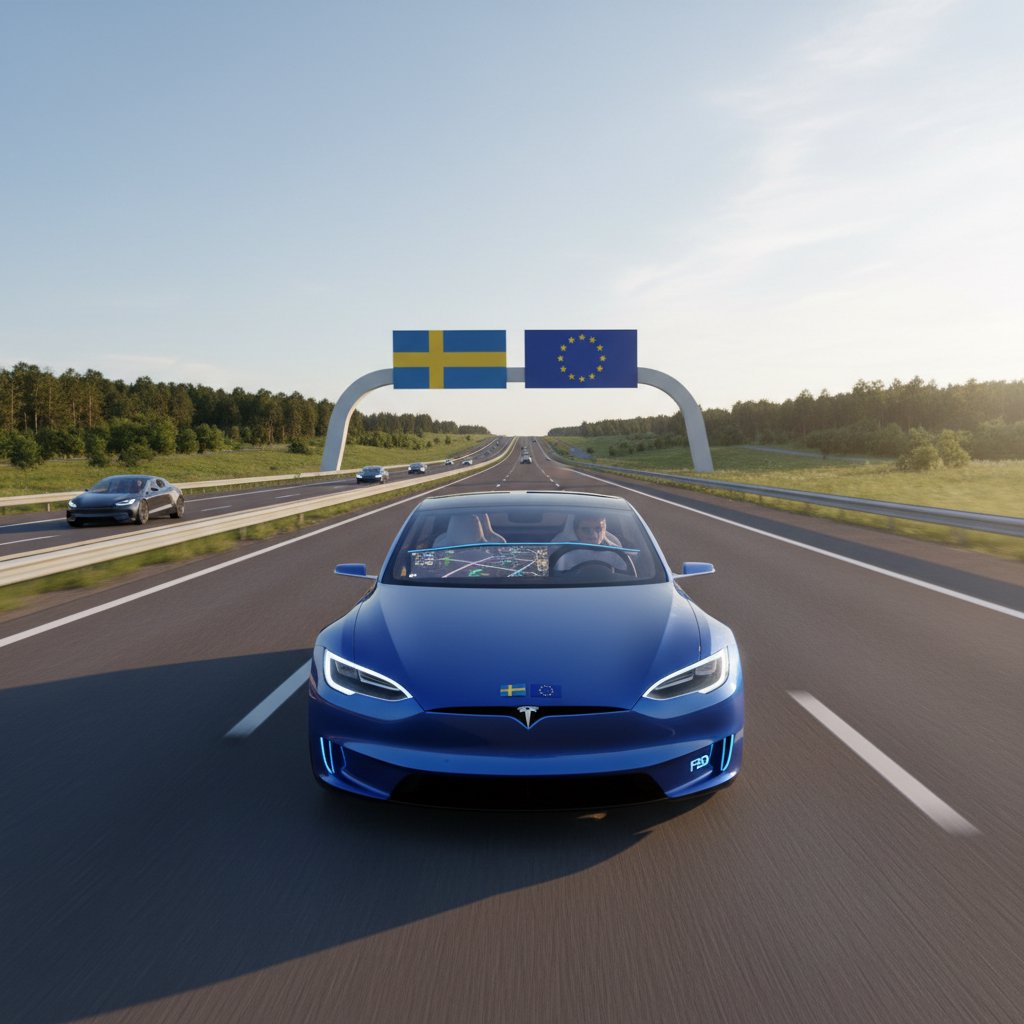
Sweden's Transport Agency (Transportstyrelsen) has confirmed that Tesla's Full Self-Driving (Supervised) is progressing through the EU type-approval process and could be available across the bloc as early as summer or fall 2026. The statement, issued in early May 2026, is the first formal signal from a Northern European regulator that the post-Netherlands rollout could go bloc-wide before the end of the year.
What the Agency Actually Said
The Transport Agency framed its assessment as a current best estimate, not a commitment. The legal pathway runs through the EU Technical Committee on Motor Vehicles (TCMV), which is scheduled to take up the Dutch RDW approval at a key meeting in late June 2026. A favourable vote would let any member state honour the Dutch type approval. If that vote slips to the autumn cycle, the broader rollout slides with it — but the agency still believes "summer or fall" remains plausible.
Sweden also confirmed it has been letting Tesla test FSD on Swedish public roads under its own national authorisation, including supervised urban testing in Nacka. That approval is the country's contribution to the data set the TCMV will consider in June.
The Caveats Coming From the Same Agency
The more interesting half of the Swedish statement is the list of open issues the agency wants resolved before any bloc-wide rollout. A Swedish Transport Agency investigator wrote in mid-April that he was "quite surprised" to learn FSD was permitted to exceed posted speed limits, and stated that this behaviour should not be allowed under European traffic law. The agency has formally raised speed-limit compliance as an issue that may need to be settled at the TCMV level.
The agency has also flagged three further concerns:
- Icy-road handling. Sweden, Finland and parts of Germany and Eastern Europe have months of mixed-friction surface every year. The agency wants documented evidence of how FSD detects and reacts to ice, packed snow and black-ice transitions before signing off on series approval.
- Phone-use circumvention. The system relies on driver attention monitoring. Swedish regulators want assurance that drivers cannot defeat the in-cabin monitoring to use their phone while FSD is active.
- Restriction to new builds. A separate Transport Agency note suggested that, in the worst case, FSD approval could be limited to vehicles built after a specific cut-off date, rather than retroactively activated for the existing Swedish fleet. That outcome would be a significant downgrade for owners who already paid for the feature outright.
Why It Matters for the Bloc
If Sweden's read is correct, the Tesla FSD timeline across Europe looks like this:
| Stage | Earliest plausible date | Status |
|---|---|---|
| Netherlands series approval | 10 April 2026 | Granted (RDW) |
| Belgian supervised testing | May 2026 | Granted (Flanders) |
| TCMV vote on EU-wide approval | Late June 2026 | Scheduled |
| Bloc-wide consumer availability | Summer–autumn 2026 | Subject to TCMV outcome |
| Resolution of speeding/icy-road open issues | Through 2026 | In dialogue |
The early-fall window only holds if the TCMV is willing to vote without first resolving the open issues, or if Tesla agrees to a constrained operational design domain (lower speeds, fair-weather restriction) for the initial bloc-wide rollout. Both outcomes are plausible — but neither is locked in.
What Tesla Owners Should Watch
For European owners, the practical question is whether to sign up for FSD now or wait. The May 21 cut-off for one-time FSD purchases across Europe (15 May in the Netherlands) is the immediate decision point: customers who want a lifetime licence have until those dates, after which only the €99-per-month subscription will be available.
The Swedish caveats add one wrinkle to that calculation: if FSD ends up restricted to newer vehicles, owners of older cars who bought the feature outright may have paid for something they cannot activate. Tesla has not commented publicly on whether the Swedish "new builds only" scenario is on the table for negotiation.
For now, Sweden's confirmation is the most concrete EU-wide timeline signal Tesla has received from a national regulator since the Dutch approval in April. The next decisive moment is the TCMV vote in late June 2026.
Update: 2026-05-18
The EU Technical Committee on Motor Vehicles (TCMV) met in Brussels on 5 May 2026 and did not vote on the Dutch FSD type approval. The Dutch RDW's presentation slot was extended from 20 minutes to 60 minutes for a more detailed Q&A with national delegations, per Electrek. The next TCMV meetings are now scheduled for July and October 2026 — the earlier 'late June 2026' timetable is no longer the working assumption. Speaking to Norwegian outlet Teknisk Ukeblad on 17 May 2026, Hans Nordin of Sweden's Transportstyrelsen added a significant new caveat: if the EU committee ultimately rejects FSD Supervised, the existing Dutch national approval will also be withdrawn. That makes the TCMV vote bidirectional rather than expansive — a no closes the Netherlands as well as the bloc.