
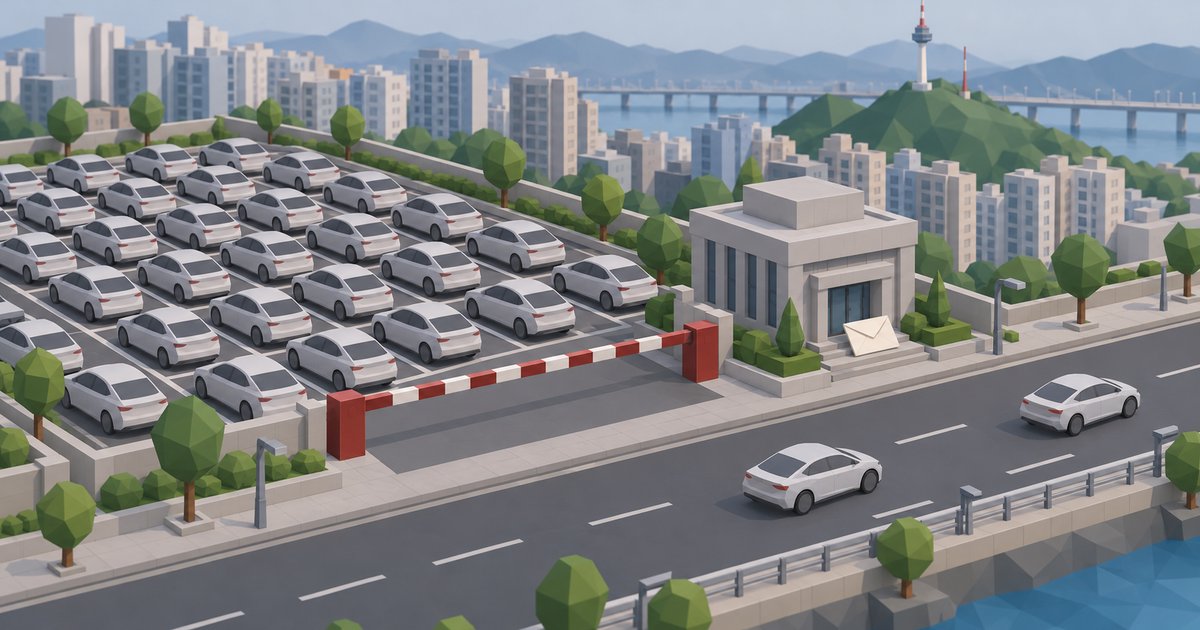
Tesla Korea has formally asked South Korea's Ministry of Land, Infrastructure and Transport (MOLIT) to approve FSD (Supervised). Minister Hong Ji-seon confirmed it at the National Assembly transport committee's closing audit on 23 October, Bloter reported. Democratic Party lawmaker Jang Jong-tae asked her about it, and she said she had heard the request was sent "by email yesterday, dated the 22nd". Jang's office says Tesla also sent it by registered mail to the ministry's mobility and automobile bureau. Neither side disclosed which models or hardware the filing covers.
Why Korea needs a filing
FSD is already on sale in Korea, but only for US-built cars. Those cars enter under the Korea–US free trade agreement, which recognises American safety standards. The Shanghai-built Model 3 and Model Y, which make up most of Tesla's Korean fleet, have no such route. MOLIT has said that FSD on them does not meet Korean safety standards. That is why the Korean v14 Lite release in August went only to cars with US VINs.
Tesla Korea gave its own figures to Jang's office, and Bloter published them after the first audit session on 8 October:
| Korean Tesla fleet, end of September 2026 | Cars |
|---|---|
| Registered | 238,968 |
| Can use FSD | 53,477 (22.4%) |
| Cannot use FSD | 185,491 (77.6%) |
| of which China-built Model 3 and Model Y | 183,407 |
| of which US-built Model S and Model X with HW3 | 2,084 |
Of the 170,178 Model Ys registered in Korea, 152,409 (89.6%) cannot use it.
What the ministry has done so far
On its own account, very little. Jang's office released data from MOLIT and the Korea Transportation Safety Authority showing no government testing or verification of FSD, and no plan for any. MOLIT says it has not judged whether the system is safe or unsafe. EBN reported that 30,303 Korean cars had driven 91.8 million km on FSD. It also reported that Tesla's own software updates, not the ministry, blocked 93 cars that had been "jailbroken" to switch the feature on.
At the 8 October session, Tesla Korea CEO Seo Young-deuk said Tesla would review the procedures and pursue a formal application. Jang pointed to a special provision in Korea's vehicle safety rules that lets the minister recognise a foreign safety standard. According to the same ministry data, UN R171, the international rule for driver-assistance systems that Korea is adopting, cannot yet accommodate FSD's city-street functions.
On 23 October Hong said the ministry would "look at the international discussions too". She began to say "Tesla's biggest problem right now is…", but her time ran out, and she gave no procedure or timetable. Jang asked for both before the regular parliamentary session ends.
What it means for Europe
In Europe, the Dutch RDW approved FSD (Supervised) under the EU's exemption procedure for new technology, and Slovakia became the ninth country to recognise it. Korea's problem is a different one. Its rules accept American standards for American-built cars, so the Shanghai cars need a Korean decision of their own. Until that decision comes, more than three quarters of the country's Teslas stay locked out.
Update: 2026-10-29
On 28 October 2026 the Korea JoongAng Daily reported, citing industry sources and a ministry official, what Tesla Korea's 22 October filing asks for, which neither side had disclosed. It covers the China-made Model 3 and Model Y: "The request is to allow FSD on China-made Teslas," the official said. Tesla Korea applied for a special exemption under Article 114-2 of MOLIT's rules on vehicle performance and safety standards, which lets the minister make an exception for a new "device" judged to outperform the standards or to be necessary for safety. Until now the provision has been used only for physical equipment, such as lighting systems and devices that stop drivers pressing the wrong pedal. "There has been no case of the exemption being applied to a software update," the official said, adding that the ministry needs to review the legal issues. A decision also requires a technical review by the Korea Automobile Testing and Research Institute (KATRI). Tesla Korea's application reportedly did not include the data for it, and the ministry plans further talks with Tesla.
Update: 2026-11-06
A MOLIT document prepared for the National Assembly, titled "Tesla FSD status and review opinion", shows how the ministry views the request, Bloter reported on 5 November. MOLIT writes that US-built Teslas already benefit from the Korea–US free trade agreement, and that it "needs to be cautious" about exempting only China-built Teslas, which the agreement does not cover, from the international and domestic standards other carmakers must meet. It also cites concern that a form of automated driving not adopted in Europe, Japan or China, or in international standards, could spread in Korea, and criticises Tesla for taking FSD orders and payments although the feature is not allowed. Bloter notes that the document was written before Tesla's 22 October filing, and that the Netherlands approved the system in April, with nine more EU countries since recognising that approval. Lawmaker Jang Jong-tae's office expects the review of the six-page application to take about two weeks.